
Why AI Courses for Professionals Matter Now
AI courses for professionals are no longer optional learning for people who simply want to understand a new trend. AI is now entering business planning, HR decisions, education, customer service, operations, governance, compliance, and leadership communication. Professionals who do not understand AI may still be able to use tools, but they may struggle to evaluate risk, interpret outputs, or guide teams responsibly.
This is an important distinction. Using AI is not the same as understanding AI in a professional context. A manager may know how to generate a report, but still not know whether the output is reliable. An HR professional may test an AI tool for recruitment, but still need to understand bias, data privacy, transparency, and human oversight. An educator may use AI for lesson planning, but still need policies for academic integrity and assessment quality.
The OECD AI Principles promote trustworthy AI that respects human rights and democratic values. They were adopted in 2019 and updated in 2024, which makes them a useful reference point for professionals who want to learn AI responsibly. Read the AI Principles.
This is why AI courses for professionals should go beyond tool demonstrations. They should help learners understand what AI can do, where it fails, what risks it creates, and how it should be governed in real organisations.
For working professionals, the real value is practical capability. A good course should help you ask better questions, make better decisions, and use AI with confidence. It should also provide credible evidence of learning, especially if you want to show development on LinkedIn, in a performance review, or in a promotion discussion.
What Makes an AI Course Professionally Useful
A professionally useful AI course is not the same as a technical AI course. Technical courses may focus on coding, model development, algorithms, machine learning engineering, or data science. Those topics are valuable, but they are not always the right starting point for managers, educators, HR professionals, consultants, compliance officers, or business leaders.
AI courses for professionals should start with business relevance. They should explain AI in plain language, connect concepts to workplace decisions, and show how AI affects roles, workflows, risk, productivity, and governance. The course should help learners become responsible users and decision-makers, not just passive observers of technology.
A strong course usually includes:
- Clear explanations of AI, machine learning, generative AI, automation, and data quality.
- Practical workplace examples.
- Guidance on responsible AI use.
- Case-based learning and realistic scenarios.
- Assessment or reflection tasks.
- Certification that confirms structured learning.
- Links between AI capability and career development.
This matters because many professionals are not trying to become AI engineers. They need enough AI literacy to lead teams, evaluate proposals, support adoption, and reduce avoidable risk.
A good AI course should also be current. AI changes quickly, but that does not mean every course should chase every new tool. The best courses teach principles that remain useful even when tools change. These include human oversight, data quality, transparency, accountability, privacy, fairness, and responsible implementation.
That is why AI courses for professionals should be judged by their ability to build judgement. The certificate matters, but the capability behind the certificate matters more.
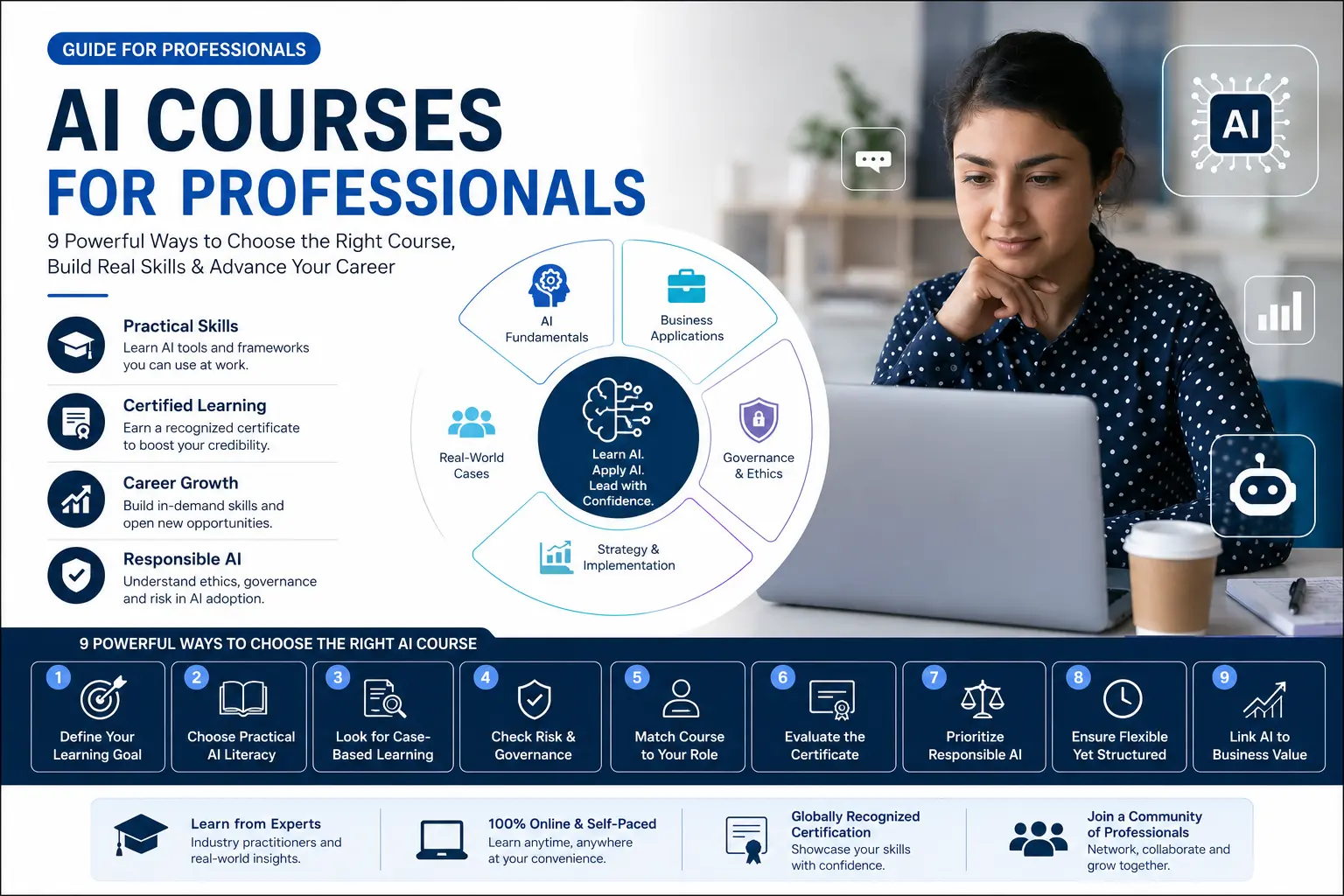
9 Powerful Ways to Choose AI Courses for Professionals
Choosing AI courses for professionals becomes easier when you evaluate them through practical criteria. The best course is not always the most technical, the most expensive, or the most popular. It is the course that fits your role, your goals, and the decisions you need to make.
1. Start with Your Professional Goal
Before choosing a course, define why you need AI learning. A general interest in AI is useful, but it is not enough to guide course selection. You need to know what capability you want to build.
A manager may need to understand AI for team productivity, workflow redesign, and decision support. An HR professional may need AI knowledge for recruitment, workforce analytics, learning and development, or employee communication. An educator may need AI capability for teaching, assessment, academic integrity, and learner support. A senior leader may need AI strategy, governance, and investment awareness.
This is why AI courses for professionals should be selected by role and purpose. If your goal is to lead AI adoption, a basic awareness course may not be enough. If your goal is to understand AI terminology, a deep technical course may be unnecessary.
A useful question is: what decision should this course help me make better?
That question keeps the learning practical. It prevents you from choosing a course only because the topic sounds current. It also helps you avoid courses that provide a lot of information but little workplace value.
2. Choose Practical AI Literacy Before Deep Technical Detail
Many professionals make the mistake of assuming that the best AI course must be highly technical. That is not always true. Technical depth matters for data scientists and developers, but many business professionals first need practical AI literacy.
AI literacy means understanding what AI is, how it works at a basic level, what its limitations are, and how it should be used responsibly. It also means knowing how to question AI outputs, identify weak use cases, and recognise when human review is essential.
AI courses for professionals should explain technical ideas without overwhelming learners with unnecessary complexity. A good course should help you understand concepts such as training data, prompts, model limitations, hallucinations, bias, privacy, automation, and human oversight in a way that connects to your work.
For example, a manager does not need to build a language model to understand that AI-generated summaries can be incomplete. An HR leader does not need to code an algorithm to know that AI-supported hiring tools require fairness checks. An educator does not need machine learning expertise to understand why assessment design must change when students have access to generative AI.
The best first step is usually practical understanding. Technical learning can come later if your role requires it.
3. Look for Case-Based Learning
AI becomes meaningful when learners apply it to realistic situations. That is why case-based learning is especially valuable in AI courses for professionals.
A case might ask learners to evaluate whether an organisation should adopt an AI chatbot. Another case may explore whether AI should be used in hiring, performance reviews, academic feedback, customer communication, or compliance reporting. These situations force learners to consider more than the tool. They must assess risk, purpose, stakeholder impact, governance, and accountability.
This is how professionals actually encounter AI. They rarely receive perfect data and simple choices. More often, they face incomplete information, vendor claims, leadership pressure, employee concerns, and unclear responsibility.
Case-based learning helps close the gap between knowing AI terms and applying AI judgement. It allows learners to test decisions in a safer environment before similar issues arise at work.
When reviewing AI courses for professionals, look for realistic examples, applied scenarios, decision prompts, reflection tasks, or case analysis. These features usually indicate that the course is designed for workplace application rather than passive awareness.
4. Check Whether the Course Covers AI Risk and Governance
Any serious AI course for professionals should address risk. AI can improve productivity, speed, analysis, and decision support, but it can also create errors, bias, privacy issues, security exposure, and reputational damage.
A course that only presents AI as a productivity tool may be incomplete. Professionals need to understand both opportunity and risk. This is especially important for managers, HR leaders, educators, compliance officers, procurement teams, and executives.
AI courses for professionals should explain governance in practical terms. Learners should understand who approves AI use, what data can be used, how outputs should be reviewed, when AI should not be used, and how risks should be escalated.
The course should also explain that different AI use cases require different levels of control. Using AI to draft an internal meeting summary is not the same as using AI to screen job applicants, evaluate students, recommend services, or support decisions that affect people’s rights or opportunities.
Good AI governance learning helps professionals avoid two extremes: unrestricted experimentation and unnecessary fear. The aim is responsible adoption.
5. Make Sure the Course Is Designed for Your Role
AI courses for professionals should not treat all learners the same. A general AI course can be useful, but role-specific learning often creates stronger value.
Managers need AI learning that connects to team productivity, workflow improvement, communication, performance, and implementation. HR professionals need AI learning that connects to recruitment, workforce planning, employee experience, ethics, and policy. Educators need AI learning that connects to teaching, assessment, learner support, academic integrity, and digital pedagogy. Senior leaders need AI learning that connects to strategy, governance, investment, and organisational capability.
The more closely the course matches your role, the easier it becomes to apply the learning quickly.
This does not mean you should avoid general AI courses. A general course can be a good foundation. But if you already understand the basics, a role-specific course may offer better professional return.
A useful test is to read the module titles and ask: do these topics reflect the decisions I actually face?
If the answer is no, the course may still be interesting, but it may not be the best investment.
6. Evaluate the Certificate, Not Just the Content
Certification matters because professional development often needs to be visible. A certificate can support your CV, LinkedIn profile, promotion case, CPD record, or internal development discussion.
However, not all certificates carry the same value. A certificate is more credible when it reflects structured learning, clear outcomes, and some form of assessment or completion standard.
When choosing AI courses for professionals, check what the certificate represents. Does it confirm completion of a defined course? Does the course include quizzes, case tasks, applied reflection, or assessment? Is the certificate verifiable? Does the provider clearly explain what was studied?
A certificate should not be the only reason to choose a course. But it should be considered carefully if you plan to use it for professional credibility.
The best AI certificates are useful because they combine capability and proof. They show that you did not simply watch videos. You completed structured learning that supports workplace use.
7. Prioritise Courses That Teach Responsible AI Use
Responsible AI is not only a topic for technical teams. It affects every professional who uses, approves, recommends, or manages AI-enabled tools.
AI courses for professionals should teach learners how to use AI in ways that are transparent, fair, secure, and accountable. This includes knowing when AI-generated content needs review, when sensitive information should not be entered into tools, when human judgement must remain central, and how to communicate AI use clearly.
Responsible AI also includes recognising limitations. AI can sound confident while being wrong. It can produce biased or incomplete results. It can summarise information in ways that miss context. It can create privacy risks if used carelessly.
Professionals who understand these limitations are more valuable because they can use AI without becoming overdependent on it. They can also help teams adopt AI in a way that improves work rather than creates new risk.
This is why responsible AI should be part of every serious AI course for managers, educators, HR professionals, and business leaders.
8. Check Flexibility Without Losing Structure
Many professionals choose online AI courses because they need flexibility. That is understandable. Full-time work, meetings, travel, family responsibilities, and shifting deadlines make fixed schedules difficult.
Self-paced courses can be highly effective, but only when they are structured well. Flexibility without structure can lead to delay. A course should have clear modules, logical progression, defined outcomes, and a manageable completion path.
AI courses for professionals should respect the time limits of working adults. Lessons should be clear, focused, and practical. The course should allow learners to revisit material when workplace questions arise.
At the same time, the course should not be so light that it becomes superficial. AI is too important for shallow learning. The best courses balance convenience with substance.
Before enrolling, review the course format. Ask whether you can complete it realistically and whether the structure will help you stay engaged. The best course is not only the one you start. It is the one you finish and use.
9. Choose Courses That Link AI to Business Value
AI learning should not end with tool use. Professionals need to understand how AI creates value in real organisations.
This includes productivity gains, better decision support, improved customer experience, faster reporting, stronger learning design, more efficient workflows, and better use of data. It also includes recognising when AI is not the right solution.
AI courses for professionals should help learners connect AI to measurable outcomes. If a course only teaches prompts, it may improve short-term productivity but miss broader strategy. If it only teaches high-level concepts, learners may struggle to apply the content. The strongest courses connect tools, strategy, risk, people, and performance.
A good course should help you ask:
- What problem are we solving?
- Why is AI the right approach?
- What data is involved?
- Who is affected?
- What risks need control?
- How will success be measured?
- What human oversight is required?
These questions turn AI learning into professional capability.
Common Mistakes When Choosing AI Courses
One common mistake is choosing the most technical course because it sounds more advanced. For many professionals, that can be the wrong fit. If your role is managerial, strategic, educational, or HR-focused, you may need practical AI judgement more than coding knowledge.
Another mistake is choosing only by certificate title. A certificate may look attractive, but the learning behind it must be credible. Check the curriculum, assessment, provider, and certificate verification process.
A third mistake is ignoring governance. AI use without risk awareness can create problems quickly. Any professional AI course should include responsible use, limitations, ethics, privacy, and accountability.
A fourth mistake is choosing a course that is too broad. General AI awareness is useful, but if your role requires specific application, you may need a more targeted course.
Finally, many learners choose courses without planning how they will apply the learning. The best return comes when you connect each module to a real workplace task, project, or decision.
Avoiding these mistakes helps you choose AI courses for professionals that build practical capability rather than passive awareness.
AI Courses for Professionals by Role
Different roles require different AI learning paths. The most useful course depends on the decisions you need to make.
AI Courses for Managers
Managers need courses that help them understand AI use cases, productivity tools, team adoption, workflow redesign, and performance impact. They should learn how to assess whether AI supports a business goal and how to manage the change that follows.
Relevant areas include AI literacy, AI operations, AI strategy, responsible use, and decision-making with AI.
AI Courses for HR Professionals
HR professionals need AI learning that addresses recruitment, workforce analytics, learning and development, employee communication, performance processes, and AI governance in people decisions.
They should also understand bias, privacy, fairness, employee trust, and human oversight.
AI Courses for Educators
Educators need AI learning that connects to teaching practice, assessment design, academic integrity, learner support, digital pedagogy, and institutional policy.
AI courses for educators should be practical, not only theoretical. They should help teachers and academic leaders make better decisions about where AI belongs in learning.
AI Courses for Executives
Executives need AI courses that focus on strategy, investment, governance, organisational readiness, accountability, and risk. They do not need to become technical specialists, but they do need enough fluency to ask better questions.
Executive AI learning should help leaders decide where AI can create value and where adoption may create exposure.
AI Courses for Operations and Project Leaders
Operations and project professionals need AI learning that supports workflow improvement, automation, process redesign, productivity, risk control, and implementation planning.
They should understand how AI affects execution, adoption, measurement, and continuous improvement.
How to Use an AI Certificate at Work
Completing an AI course is only the first step. The value increases when you use the certificate strategically.
Add the certificate to your LinkedIn profile, CV, or professional portfolio. But do not stop there. Explain what the course helped you do. For example, you might say that you developed stronger capability in evaluating AI use cases, understanding AI risk, or applying AI tools responsibly in workplace settings.
You can also use the learning in performance reviews or promotion discussions. Rather than presenting the certificate as a badge, connect it to business value. Show how the learning supports your role, your team, or your organisation’s future direction.
For managers, this may mean improving team productivity. For HR professionals, it may mean assessing AI tools more responsibly. For educators, it may mean redesigning assessment policies. For executives, it may mean asking sharper governance questions.
AI courses for professionals pay off when the learning becomes visible in decisions, communication, and workplace results.
Recommended The Case HQ Courses
If you want practical, self-paced AI learning with certification, applied cases, and workplace relevance, these The Case HQ courses are especially relevant:
- Certified AI Business Strategist (CAIBS)
- Certified Chief AI Officer (CAIO)
- Certified AI Business Steward (CAIBST)
- Certified AI Operations Manager
- Certified AI Strategic HR Leader (AI-SHRL)
- Certified AI Procurement and Vendor Evaluation Professional
- Certified AI Data Protection Officer (CAIDPO)
- Artificial Intelligence for Educational Leadership
Further Reading
To continue building practical AI and professional learning capability, you may also find these The Case HQ blog resources useful:
- How to Choose an AI Strategy Course Online
- Best AI Courses for Managers
- AI Training vs AI Certification Explained
- AI Governance Course: What to Look For
- How to Build AI Governance That Works
- AI Governance vs Compliance
FAQs
What are AI courses for professionals?
AI courses for professionals are courses designed for non-technical and business-focused learners who need to understand AI for workplace use. They usually focus on AI literacy, business applications, responsible use, governance, productivity, and decision-making rather than coding or advanced model development.
Who should take AI courses for professionals?
Managers, HR professionals, educators, consultants, executives, operations leaders, project managers, and business specialists can benefit from AI courses for professionals. These courses are especially useful for people who need to evaluate AI tools, support adoption, manage risk, or lead teams through AI-enabled change.
Are AI courses for professionals technical?
Some AI courses are technical, but AI courses for professionals usually focus on practical understanding rather than coding. They explain AI concepts in business language and connect them to workplace decisions, productivity, governance, ethics, and implementation.
What should I look for in an AI course?
Look for clear learning outcomes, practical examples, case-based learning, responsible AI coverage, assessment, certificate verification, and relevance to your role. The best AI courses for professionals help you apply AI in real work, not only understand terminology.
Do AI certificates help career growth?
AI certificates can support career growth when they represent credible, structured learning. A certificate can strengthen a CV, LinkedIn profile, performance review, or promotion case, especially when you can explain how the course improved your professional capability.
Which AI course should managers start with?
Managers should usually start with a course that covers AI literacy, business use cases, governance, implementation risks, and team adoption. A course such as Certified AI Business Strategist or Certified AI Operations Manager can be useful if the goal is practical business application.
Final Thought
AI courses for professionals should help you build more than awareness. They should help you make better decisions, lead more confidently, evaluate tools responsibly, and communicate AI opportunities and risks with clarity.
The best course is not always the most technical or the most popular. It is the one that fits your role, strengthens your judgement, and gives you credible evidence of professional development.
Choose AI courses for professionals that help you use AI thoughtfully, responsibly, and effectively in the work you are already doing and the responsibilities you are preparing to take on next.
Responses