

Why Digital Transformation Skills Matter
Digital transformation skills matter because digital change is no longer limited to IT teams. It now affects leadership, HR, finance, operations, education, governance, customer service, project management and strategic planning. Professionals are expected to use digital tools, interpret data, work with AI, redesign processes and guide teams through change.
OECD explains that digital environments require more than basic technology use. Complementary skills such as teamwork, autonomy, problem solving, creative thinking, communication, collaboration, emotional intelligence and continuous learning can significantly improve effectiveness and productivity in digital work settings. Read skills for the digital age resource.
This is exactly why digital transformation skills should be understood broadly. They are not only technical skills. They are a combination of digital awareness, business judgement, process thinking, data literacy, change leadership and responsible technology use.
A manager may not need to configure a cloud platform, but they do need to understand how the platform changes workflows. An HR professional may not need to build an AI model, but they do need to understand how AI affects hiring, workforce planning and employee trust. An educator may not need to code a learning platform, but they do need to understand how digital tools affect teaching, assessment and learner engagement.
Digital transformation skills help professionals ask better questions. What problem are we solving? What process needs redesign? What data supports the decision? What risk does the tool create? What training do teams need? How will success be measured?
Without these skills, digital transformation becomes a technology project. With these skills, it becomes a business capability.
What Digital Transformation Skills Really Mean
Digital transformation skills are the capabilities professionals need to use technology, data, AI and process redesign to improve performance. They include technical awareness, but they are not limited to technical knowledge.
The most useful skills sit at the intersection of people, process, technology and strategy. A professional with strong digital transformation capability can understand a business problem, evaluate whether digital tools can help, support adoption, manage risk and measure impact.
This matters because many organisations fail at digital transformation not because the technology is weak, but because people are not ready to work differently. Teams continue using old spreadsheets. Managers keep asking for manual reports. Employees resist new workflows because they do not understand the purpose. Leaders approve platforms without changing decision rights or accountability.
Digital transformation skills help close that gap.
They allow professionals to translate digital ambition into practical work. That may mean improving a workflow, redesigning a customer journey, using data more effectively, introducing AI responsibly, or supporting teams through change.
These skills are also career-relevant. Professionals who can connect digital tools to business outcomes are more valuable because they can contribute beyond their functional job title. They can participate in transformation projects, support innovation, advise leaders and help teams adapt.
The strongest digital transformation skills are therefore not only about knowing technology. They are about applying judgement in digital environments.
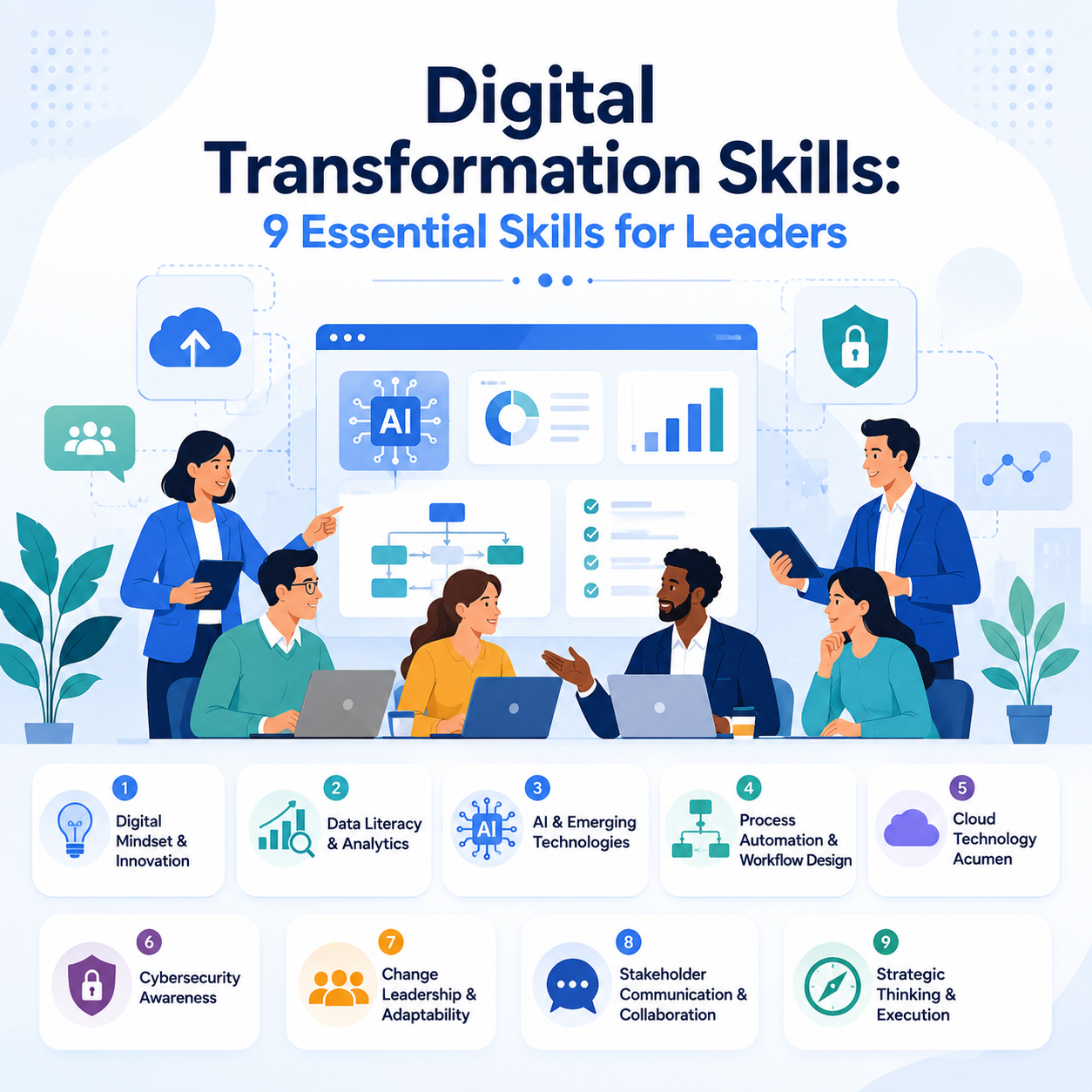
9 Essential Digital Transformation Skills for Leaders
The following nine digital transformation skills are especially important for leaders, managers and professionals who want to contribute meaningfully to digital change.
1. Digital Literacy
Digital literacy is the foundation of all digital transformation skills. It means understanding the basic tools, systems and concepts that shape modern work. This includes cloud platforms, automation, AI, digital workflows, cybersecurity basics, data systems and collaboration tools.
Digital literacy does not mean knowing every technical detail. It means having enough understanding to participate in digital conversations, ask informed questions and avoid being excluded from decisions.
For managers, digital literacy helps with practical judgement. If a team is using a new project management platform, the manager should understand how it affects visibility, accountability and reporting. If an organisation introduces an AI tool, the manager should know what it can and cannot do.
Digital literacy also supports confidence. Professionals who feel digitally uncertain may avoid new tools or rely too heavily on others. That can slow adoption and reduce influence. A digitally literate professional is more likely to test tools, ask questions and contribute constructively.
This is why digital transformation skills should always begin with literacy. Before people can lead digital change, they need a practical understanding of the digital environment around them.
2. Data Literacy
Data literacy is one of the most important digital transformation skills because digital decisions increasingly depend on data. Professionals need to understand what data means, where it comes from and how it should be interpreted.
A dashboard can look impressive and still mislead decision-makers. If the data is incomplete, outdated or poorly defined, the resulting decisions may be weak. Data literacy helps professionals avoid false certainty.
Useful data literacy includes understanding basic metrics, data quality, visualisation, reporting definitions, privacy, data ownership and the difference between activity measures and outcome measures.
For example, a customer service dashboard may show faster response times, but that does not automatically mean better service. If customer satisfaction is declining, the speed metric may be incomplete. An HR dashboard may show reduced turnover, but the data may hide rising disengagement among high performers.
Professionals with strong data literacy know how to ask better questions. What does this metric measure? What is missing? Is the data reliable? Does the data show cause or only correlation? What decision should this data support?
Data literacy is also essential for AI readiness. AI systems depend on data, and weak data can produce weak recommendations. This makes data literacy a core skill for managers, HR leaders, educators, operations professionals and executives.
3. Process Redesign
Digital transformation often fails when organisations digitise broken processes. Process redesign is the skill of understanding how work actually happens and improving it before or during digital adoption.
This skill matters because technology does not automatically fix unclear roles, duplicated approvals or poor handoffs. If a process is slow because decision rights are unclear, a digital platform may only make the delay more visible.
Process redesign starts with mapping the current workflow. Who starts the process? Who approves? Where does information move? Where does work stop? Which steps create value? Which steps create friction?
Once the process is visible, teams can decide what should change. Some steps may be removed. Others may be automated. Some decisions may need clearer ownership. Some controls may need strengthening.
For example, an organisation may introduce a digital HR onboarding system. If the underlying onboarding process is fragmented, the system will not solve the problem alone. The organisation may still need clearer responsibilities, better communication and standardised handoffs between HR, IT and line managers.
Process redesign is one of the digital transformation skills that separates real transformation from surface-level modernisation. It ensures that technology supports better work, not just digital versions of old inefficiencies.
4. AI Awareness
AI awareness is now a core digital transformation skill. Professionals do not need to become AI engineers, but they do need to understand how AI affects work, decisions and risk.
AI awareness includes understanding generative AI, automation, machine learning, prompts, hallucinations, bias, human oversight and AI governance. More importantly, it includes knowing where AI can add value and where caution is needed.
AI can support productivity, reporting, analysis, customer service, learning design and decision support. But it can also create risks if outputs are inaccurate, biased, poorly reviewed or used inappropriately.
For example, using AI to draft a meeting summary may be useful. Using AI to make final hiring decisions without oversight may be risky. Using AI to generate policy language may save time, but expert review remains essential.
Professionals with AI awareness can evaluate use cases more responsibly. They can ask what data is being used, who reviews outputs, what risks exist and how success will be measured.
This is why AI awareness should be part of digital transformation skills for managers, HR professionals, educators, governance teams and senior leaders. AI is no longer a separate topic. It is part of digital transformation.
5. Change Management
Digital transformation is change management. New tools change routines, expectations, responsibilities and behaviours. Without change management skills, digital projects often fail to deliver value.
Change management includes communication, stakeholder engagement, training, resistance management, adoption planning and reinforcement. It helps people understand why change is happening and what they need to do differently.
Many organisations underestimate the emotional side of digital change. Employees may fear job loss, increased monitoring, skill exposure or loss of control. Managers may feel pressure to lead tools they do not fully understand. Leaders may expect adoption faster than teams can realistically manage.
Change management skills help professionals respond to these concerns. They also help organisations sequence change more effectively. Not every transformation should happen at once. Teams need time, support and clarity.
A strong change manager can explain the purpose of digital change, listen to concerns, identify adoption barriers and support behaviour change after launch.
This makes change management one of the most valuable digital transformation skills for managers and leaders. Technology may enable transformation, but people deliver it.
6. Cybersecurity and Digital Risk Awareness
Cybersecurity and digital risk awareness are essential digital transformation skills because every digital tool creates some form of exposure. Professionals need to understand basic risks even if they are not cybersecurity specialists.
Digital risk can include data breaches, phishing, weak access controls, vendor vulnerabilities, poor system configuration, privacy issues, AI misuse and compliance failures. These risks affect trust, operations and reputation.
Managers and professionals need to know how their behaviour affects risk. For example, using unapproved tools, sharing sensitive data, reusing passwords or failing to report incidents can create serious problems.
Digital risk awareness also supports better decision-making. When evaluating a new tool, professionals should ask about data storage, access rights, vendor controls, user permissions and incident response. These are not only technical questions. They are business questions.
This skill is especially important as organisations adopt AI and cloud-based platforms. Employees may not realise that entering sensitive information into public AI tools can create exposure. Managers must be able to guide responsible use.
Cybersecurity awareness does not mean slowing innovation. It means making digital transformation sustainable and trustworthy.
7. Digital Communication and Collaboration
Digital transformation changes how people communicate and collaborate. Teams may work across platforms, locations, time zones and hybrid schedules. This makes digital communication a practical leadership skill.
Digital communication includes writing clearly, choosing the right channel, documenting decisions, managing asynchronous work and reducing confusion in digital environments.
A vague instruction in a meeting can sometimes be corrected immediately. A vague message in a project platform may create delays across multiple teams. Professionals need to communicate in ways that are searchable, concise and action-oriented.
Collaboration skills also matter. Digital tools can improve teamwork, but only if people understand how to use them consistently. Teams need shared norms for file storage, task ownership, feedback, approvals and version control.
This skill is often overlooked because organisations assume communication will improve once tools are introduced. In reality, tools only support communication. They do not create clarity by themselves.
Digital transformation skills must therefore include the ability to collaborate effectively in digital settings. This is especially important for managers, project leads, educators and remote or hybrid teams.
8. Strategic Digital Thinking
Strategic digital thinking is the ability to connect digital initiatives to business goals. This is one of the most important digital transformation skills for leaders and senior professionals.
Strategic digital thinking helps professionals avoid tool-first decisions. Instead of asking, “Which platform should we buy?” they ask, “What problem are we solving, and what capability do we need?”
This skill includes understanding customer value, operational efficiency, business models, digital strategy, investment priorities and competitive change. It also includes knowing what not to do.
For example, an organisation may be tempted to automate a process because automation seems modern. Strategic thinking asks whether automation will improve the right outcome. It may turn out that the real issue is unclear policy, poor data or weak accountability.
Strategic digital thinking also helps leaders sequence transformation. Some initiatives require foundational work before visible innovation. Data governance, process standardisation and workforce training may need to come before AI scaling.
Professionals with this skill are better able to contribute to executive discussions, transformation planning and investment decisions. They understand digital change as a business capability, not just a technology agenda.
9. Continuous Learning and Adaptability
Digital transformation is not a one-time event. Tools change, AI evolves, workflows shift and expectations rise. Continuous learning and adaptability are therefore essential digital transformation skills.
Professionals cannot rely only on what they learned years ago. They need the habit of updating knowledge, testing new tools, reviewing practices and learning from feedback.
Adaptability does not mean chasing every trend. It means staying open to better ways of working while still applying judgement. Not every new tool deserves adoption. Not every old process should remain. Professionals need to evaluate change thoughtfully.
Continuous learning also supports career growth. People who build digital capability over time are more prepared for new roles, leadership opportunities and cross-functional projects.
Organisations benefit too. A workforce with strong learning habits can respond more quickly to technology change. Instead of waiting for external support every time a new tool appears, teams build internal confidence.
This is why digital transformation skills should include learning itself. The ability to keep learning may be the most durable skill of all.
Digital Transformation Skills by Role
Different professionals need different levels of digital transformation capability. The core skills overlap, but the application changes by role.
Senior Leaders
Senior leaders need strategic digital thinking, governance awareness, AI readiness, investment judgement and change leadership. They must connect digital transformation to business priorities and organisational capability.
Middle Managers
Middle managers need process redesign, change communication, digital collaboration, data literacy and adoption support. They translate transformation strategy into daily work.
HR Professionals
HR professionals need digital transformation skills related to workforce planning, skills mapping, AI in HR, employee experience, digital learning and change management.
Operations Managers
Operations managers need process redesign, automation awareness, data use, quality improvement and workflow analysis. Their focus is often efficiency and consistency.
Project Managers
Project managers need digital implementation skills, stakeholder communication, risk monitoring, reporting discipline and adoption planning.
Educators and Learning Professionals
Educators need digital pedagogy, AI awareness, assessment redesign, learner engagement strategies and digital course delivery capability.
Governance and Compliance Teams
Governance professionals need digital risk awareness, AI governance, data protection, vendor evaluation and accountability frameworks.
This role-based view helps organisations design better training. Digital transformation skills should be matched to actual responsibilities.
Common Mistakes Professionals Make
One common mistake is thinking digital transformation skills are only technical. Technical skills matter, but transformation also requires communication, strategy, process redesign, data interpretation and change leadership.
Another mistake is learning tools without understanding workflows. A professional may know how to use a platform but still fail to improve the process around it.
A third mistake is ignoring data quality. Digital systems produce information, but not all information is useful. Professionals need to question metrics and assumptions.
A fourth mistake is treating AI as separate from digital transformation. AI is now part of digital work, and professionals need to understand its risks and opportunities.
A fifth mistake is assuming one course is enough forever. Digital capability needs continuous updating.
Finally, some professionals focus only on certificates. Certification is useful, but it should reflect practical capability. The real value is being able to apply the learning at work.
Avoiding these mistakes helps professionals build digital transformation skills that support real performance, not only professional visibility.
How to Build Digital Transformation Skills
Building digital transformation skills starts with honest self-assessment. Identify which areas are strongest and which need development. You may already be confident with digital tools but weaker in data interpretation. You may understand strategy but need more confidence with AI. You may manage teams well but need stronger process redesign skills.
The next step is choosing structured learning. Self-paced online courses can work well for professionals because they allow learning around work commitments. However, the course should have clear outcomes, practical examples and credible certification.
Case-based learning is especially useful. It allows professionals to practise judgement in realistic scenarios. This matters because digital transformation rarely happens in perfect conditions. Teams face incomplete data, resistance, budget pressure and competing priorities.
Professionals should also apply learning quickly. After each module or topic, ask: where does this show up in my work? Which process could I review? Which digital tool needs better governance? Which team habit could improve?
Application makes learning stick.
Finally, build a learning sequence. Start with digital literacy, then move into data, AI, process redesign, change leadership and governance. Over time, this creates a stronger professional profile.
Recommended The Case HQ Courses
If you want practical, self-paced learning in digital transformation, AI, governance, operations and leadership, these The Case HQ courses are especially relevant:
- Certified Digital Culture Advocate
- Certified AI Business Strategist (CAIBS)
- Certified AI Operations Manager
- Certified Chief AI Officer (CAIO)
- Certified AI Business Steward (CAIBST)
- Certified Project Risk and Controls Professional
- Certificate in Strategic Leadership for Directors
- Certificate in Corporate Governance: From Principles to Practice
Further Reading
To continue building practical capability in digital transformation, AI and professional learning, you may also find these The Case HQ blog resources useful:
- Digital Transformation Training: 8 Powerful Benefits for Teams
- Digital Strategy vs Digital Transformation
- 7 Digital Transformation Strategy Examples
- What Is Digital Transformation Strategy?
- Best Digital Transformation Course Online
- Who Needs Digital Transformation Training?
- Digital Skills for Executives That Matter
FAQs
What are digital transformation skills?
Digital transformation skills are the capabilities professionals need to use technology, data, AI, process redesign and change management to improve business performance. They include digital literacy, data literacy, process thinking, AI awareness, risk awareness and strategic judgement.
Why are digital transformation skills important?
They are important because digital transformation depends on people, not only technology. Professionals need the skills to adopt tools, redesign workflows, interpret data, manage change and connect digital investment to measurable value.
Do digital transformation skills require coding?
Not always. Some technical roles require coding, but most managers, HR professionals, educators and leaders need practical digital fluency rather than programming skills. They need to understand how technology affects work and decisions.
Which digital transformation skill is most important?
The most important skill is strategic digital judgement. Professionals need to understand which digital changes support real business outcomes and which simply add activity without value.
How can professionals build digital transformation skills?
Professionals can build these skills through structured online courses, case-based learning, practical workplace projects, AI and data training, process improvement work and continuous learning.
Who needs digital transformation skills?
Senior leaders, managers, HR professionals, educators, operations teams, project managers, governance professionals and employees involved in digital change all need digital transformation skills.
Can digital transformation skills help career growth?
Yes. Professionals with these skills are better prepared for leadership, transformation, AI adoption, process improvement, governance and strategy roles. A verified certificate can also support professional credibility.
Final Thought
Digital transformation skills are not only about understanding technology. They are about improving judgement, redesigning work, using data responsibly, leading change and creating measurable value.
The professionals who succeed in digital environments will not simply be those who know the latest tools. They will be those who can connect technology to people, processes, strategy and outcomes.
Digital transformation skills help leaders and professionals move from digital activity to real transformation.
Responses