

Why AI Skills for Managers Matter Now
AI skills for managers matter because AI is no longer restricted to technical teams. It is now shaping meetings, reports, hiring workflows, customer service, operational planning, training, marketing, decision support and performance analysis. Managers may not build AI systems, but they increasingly approve, supervise, interpret or respond to them.
That shift changes the role of management. A manager can no longer treat AI as something only IT understands. They need enough fluency to know what AI can do, where it can fail, which risks matter, and how people should use it responsibly.
NIST’s AI Risk Management Framework explains that AI risk management should help organisations incorporate trustworthiness considerations into the design, development, use and evaluation of AI systems. This is directly relevant to AI skills for managers because managers are often responsible for translating AI use into safe, practical and accountable workplace behaviour. Read the NIST AI Risk Management Framework.
In many organisations, the biggest AI gap is not tool access. It is managerial judgement. Teams may already be using generative AI, automation tools, analytics dashboards or AI-enabled platforms. The question is whether managers can guide that use clearly.
Without AI skills, managers may approve tools without understanding risk. They may reject useful opportunities because they feel uncertain. They may allow inconsistent use across teams. They may also struggle to explain AI decisions to employees, customers or senior leaders.
This is why AI skills for managers should be treated as core leadership skills. AI affects productivity, trust, communication, governance and work design. Managers who understand those links can lead more confidently in modern workplaces.
What AI Skills for Managers Really Mean
AI skills for managers do not mean advanced coding, data science or algorithm design. Those skills matter for technical specialists, but most managers need a different form of capability.
They need practical AI literacy. They need to understand basic AI concepts, evaluate use cases, ask informed questions, manage people through AI-enabled change, and recognise when human oversight is required. They also need to understand responsible AI use because AI decisions can affect employees, customers, learners, suppliers and organisational reputation.
A manager with strong AI capability can do several things well. They can identify where AI may improve work. They can assess whether a tool fits the business problem. They can challenge exaggerated claims. They can protect sensitive information. They can guide their team on acceptable AI use. They can evaluate outputs instead of trusting them blindly.
These are practical skills. They appear in everyday decisions.
For example, a manager may need to decide whether staff can use AI to draft customer emails. Another may need to review an AI-generated report before sending it to leadership. An HR manager may need to assess whether AI should support recruitment screening. A project manager may need to decide whether automation can reduce reporting delays.
In each case, the skill is not only technical understanding. It is judgement.
AI skills for managers therefore sit at the intersection of business, people, risk, data and communication. The strongest managers will not be those who use AI most loudly. They will be those who use it thoughtfully, responsibly and effectively.
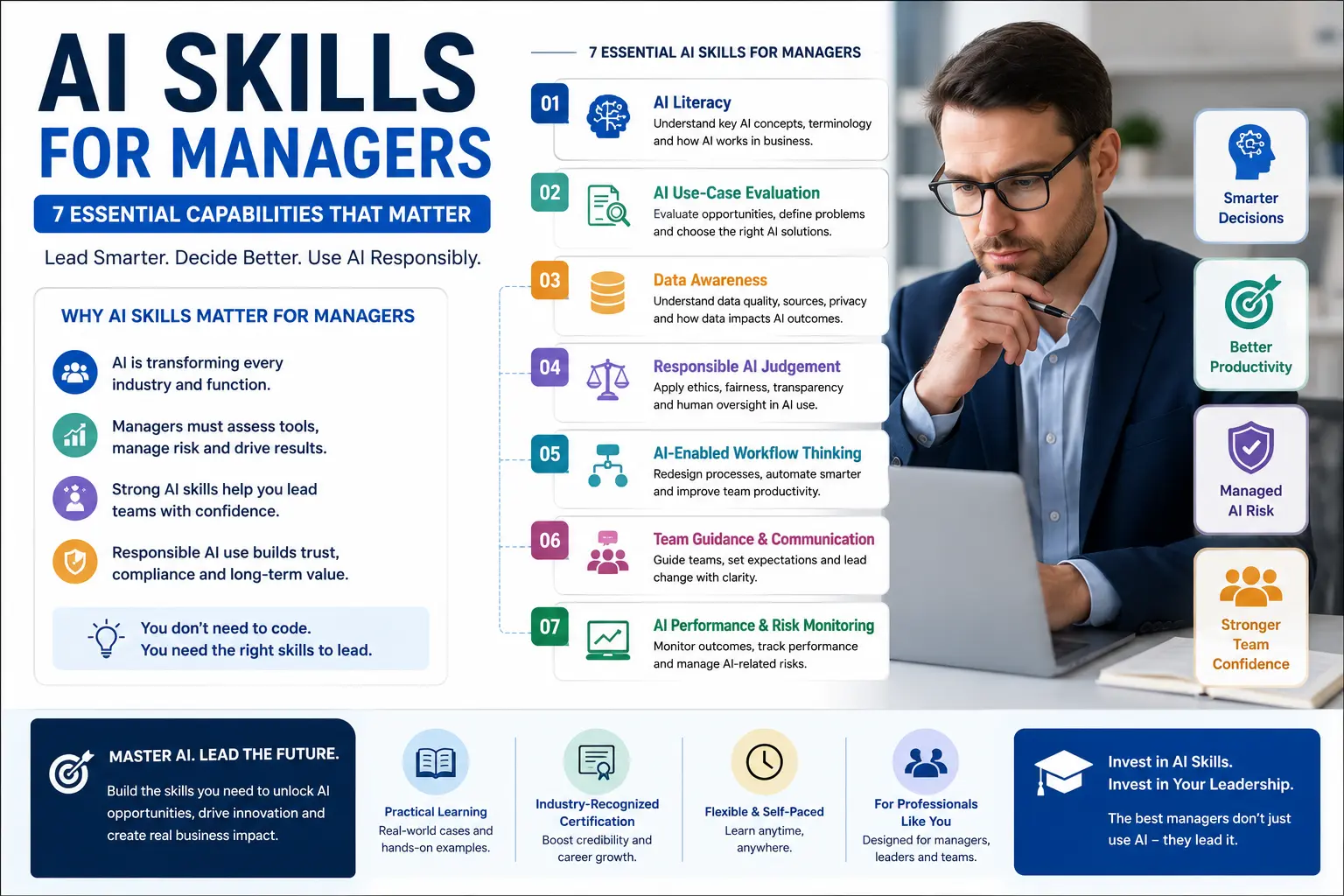
7 Essential AI Skills for Managers
The following seven AI skills for managers are the capabilities most likely to matter in real workplace settings. They are practical, role-relevant and suitable for managers who need to lead AI-enabled work without becoming technical specialists.
1. AI Literacy
AI literacy is the foundation. Managers need to understand what AI is, what generative AI does, how automation differs from intelligence, why data quality matters, and why AI outputs can be wrong even when they sound confident.
This skill matters because managers are often responsible for interpreting AI in business language. If they do not understand the basics, they may either overtrust AI or dismiss it unnecessarily.
AI literacy includes knowing common terms such as machine learning, generative AI, prompts, training data, hallucinations, bias, automation and human oversight. But vocabulary alone is not enough. Managers also need to understand how these ideas affect workplace decisions.
For example, if a generative AI tool produces a convincing policy draft, a manager should know that the output still needs review. If an AI dashboard predicts customer churn, the manager should ask what data was used, how accurate the model is, and whether the prediction supports action.
AI skills for managers begin with this level of informed questioning. A manager does not need to know every technical detail. They do need enough understanding to avoid blind trust and unnecessary fear.
Strong AI literacy helps managers communicate clearly with both technical and non-technical colleagues. It also gives them confidence to participate in AI-related discussions instead of stepping back because the topic feels too technical.
2. AI Use-Case Evaluation
Managers need to know how to evaluate whether AI is the right solution for a specific business problem. This is one of the most important AI skills for managers because many organisations rush into AI adoption without defining the problem clearly.
A good use-case evaluation starts with simple questions. What problem are we solving? Is AI necessary? What outcome do we expect? What data is required? Who will use the tool? What happens if the output is wrong? How will success be measured?
These questions help managers move beyond excitement. AI should not be adopted only because it is available. It should be used when it improves a real process, decision or outcome.
For example, AI may be useful for summarising customer feedback, drafting routine documents, identifying patterns in service requests or supporting learning recommendations. But it may be risky or unsuitable for decisions that require sensitive judgement, such as employee discipline, final hiring decisions or high-stakes compliance approvals.
A manager with strong use-case evaluation skills can distinguish between a useful pilot and a risky experiment. They can also explain why some AI opportunities should be prioritised while others should wait.
This skill is especially valuable because vendors often present AI tools in optimistic terms. Managers need the confidence to ask practical questions before approving adoption.
AI skills for managers must therefore include the ability to connect AI use to business value, operational fit and risk level.
3. Data Awareness
AI depends on data. Managers do not need to become data scientists, but they must understand that poor data can produce poor outputs. This is one of the most overlooked AI skills for managers.
Data awareness means understanding where data comes from, how complete it is, how current it is, and whether it is suitable for the decision being made. It also means recognising that data can reflect past bias, missing context or inconsistent recording practices.
For example, an AI tool may recommend staffing changes based on productivity data. But if the data ignores workload complexity, customer difficulty or team experience, the recommendation may be misleading. A manager who understands data limitations will not accept the output without challenge.
Data awareness also matters for privacy. Managers need to know whether sensitive employee, customer or organisational information can be entered into AI tools. Many risks begin when staff use public AI systems without understanding data exposure.
This skill helps managers ask better questions:
- What data is the tool using?
- Is the data accurate?
- Is the data allowed to be used?
- Who owns the data?
- What is missing from the dataset?
- Could the data create unfair outcomes?
These questions do not require advanced technical expertise. They require disciplined managerial thinking.
AI skills for managers should always include data awareness because AI decisions are only as strong as the information behind them.
4. Responsible AI Judgement
Responsible AI judgement is the ability to use AI in ways that are ethical, fair, secure, transparent and accountable. This skill is becoming essential because managers often sit between policy and practice.
An organisation may have an AI policy, but managers influence whether that policy is actually followed. They decide what team members can use, how outputs are reviewed, and when an issue should be escalated.
Responsible AI judgement includes understanding bias, privacy, explainability, accountability, transparency and human oversight. It also includes knowing when AI should not be used.
For example, using AI to brainstorm ideas may be low risk. Using AI to assess employee performance may be high risk. Using AI to draft a public statement may be acceptable if reviewed carefully. Using AI to generate legal or compliance advice without expert review may be dangerous.
Managers need to recognise these differences.
Responsible AI also involves communication. If AI is used in a process, managers may need to explain how it supports the work, what humans still control, and how concerns can be raised. This is especially important when AI affects employees or customers.
AI skills for managers are incomplete without responsible AI judgement. Productivity gains are useful, but not if they create trust problems, compliance exposure or unfair outcomes.
Managers who understand responsible AI are better prepared to lead adoption in a way that protects both performance and credibility.
5. AI-Enabled Workflow Thinking
AI can improve work, but only when managers understand the workflow around it. This is why workflow thinking is one of the most practical AI skills for managers.
Many AI projects fail because organisations add tools to broken processes. The result is faster confusion. AI may generate outputs quickly, but if approval routes, responsibilities, data flows or handoffs are unclear, the overall process may still fail.
Workflow thinking means looking at how work actually moves through a team. Where are the delays? Where does rework happen? Which tasks are repetitive? Which decisions require judgement? Which parts of the process should remain human-led?
For example, a manager may use AI to support report drafting. But the workflow still needs clear rules. Who checks the output? What sources are allowed? What tone is appropriate? What information must never be included? How will final approval happen?
AI can also change roles. If AI reduces administrative work, employees may need to shift towards analysis, review, communication or problem-solving. Managers need to prepare teams for that shift.
AI skills for managers therefore include the ability to redesign work, not just introduce tools. A manager should ask whether AI improves the process or simply adds another step.
This skill is particularly useful in operations, HR, education, customer service, project management and administrative functions where routine tasks can be improved through automation or AI support.
6. Team Guidance and Change Communication
AI adoption affects people. It can create excitement, fear, confusion or resistance. Managers need to guide teams through that emotional and practical transition.
This is one of the most human AI skills for managers. A manager may understand the tool, but still fail if they cannot communicate why it matters, how it should be used, and what support employees will receive.
Team guidance includes setting expectations. Employees need to know which AI tools are approved, what tasks they can use them for, what information must remain confidential, and when human review is required.
Change communication also matters. If AI is introduced without explanation, employees may assume it is designed to replace them, monitor them or reduce trust. Managers need to explain the purpose clearly.
Good communication should answer:
- Why are we using AI?
- What problem does it help solve?
- What will change in daily work?
- What will not change?
- What support will employees receive?
- How will risks be managed?
Managers should also listen. Employees often see practical risks that leaders miss. They know where workflows are fragile, where data is messy and where customers may react poorly.
AI skills for managers therefore include the ability to lead conversations, not only manage systems. Successful AI adoption depends on trust, clarity and support.
7. AI Performance and Risk Monitoring
AI use does not end at launch. Managers need to monitor whether AI is actually improving performance and whether risks are emerging over time.
This skill matters because AI tools can drift, produce inconsistent outputs, or become misused as teams adapt them for new purposes. A tool that works well in a pilot may perform differently at scale.
Managers need to track both value and risk. Value may include time saved, improved response quality, faster reporting, better decision support or reduced administrative burden. Risk may include errors, employee concerns, customer complaints, privacy issues, inconsistent outputs or overreliance.
AI skills for managers should include the habit of review. Managers should ask:
- Is the tool being used as intended?
- Are outputs being checked?
- Are errors being reported?
- Are employees overusing or misusing the tool?
- Are customers or stakeholders affected?
- Is the benefit measurable?
- Do controls need adjustment?
Monitoring does not mean creating unnecessary bureaucracy. It means treating AI as an ongoing management responsibility.
Managers who monitor AI use carefully can improve adoption, reduce harm and build stronger confidence among stakeholders.
This skill is especially important as organisations move from experimentation to wider AI implementation. The more AI becomes embedded in work, the more managers need to manage it like any other business capability.
Common Mistakes Managers Make with AI
One common mistake is treating AI as a shortcut rather than a decision-support tool. AI can help managers work faster, but speed without review can create poor decisions. Outputs still need judgement, context and accountability.
Another mistake is delegating AI completely to technical teams. Technical expertise is important, but AI affects business processes, people, risk and customer outcomes. Managers need to stay involved.
A third mistake is allowing unmanaged team use. Employees may experiment with AI tools before policies are clear. Without guidance, they may expose sensitive data, produce inconsistent work or rely on outputs without checking them.
A fourth mistake is focusing only on productivity. AI can save time, but managers should also consider quality, fairness, trust, compliance and long-term capability.
A fifth mistake is ignoring training. Teams cannot be expected to use AI responsibly if they have not been taught what responsible use means.
Avoiding these mistakes requires practical AI skills for managers. Managers do not need perfect knowledge, but they do need enough understanding to guide action, ask questions and set expectations.
How Managers Can Build AI Capability
Managers can build AI capability through a structured learning path. The first step is AI literacy. Understand basic terms, common tools, limitations and workplace use cases.
The second step is role-based application. Connect AI to the work you actually manage. A customer service manager should examine service workflows. An HR manager should study people-related AI risks. An operations manager should look at automation and process improvement. An educator should examine teaching, assessment and academic integrity.
The third step is responsible use. Managers should understand policy, governance, data handling, fairness and human oversight. This is the difference between casual AI use and professional AI capability.
The fourth step is practice. AI skills improve when managers apply them to real scenarios. Case-based learning is useful because it allows managers to test judgement before making high-stakes decisions.
The fifth step is continuous review. AI tools and expectations change quickly. Managers should revisit their learning, update team guidance and stay aware of new organisational policies.
Courses, certificates and applied learning can accelerate this process. The strongest programmes help managers move from awareness to workplace action.
AI Skills for Managers by Role
AI skills for managers differ slightly depending on the role. The foundation is similar, but the application changes.
General Managers
General managers need AI skills that support business decision-making, team productivity, workflow improvement and strategic planning. They should be able to evaluate AI opportunities and decide where adoption makes sense.
HR Managers
HR managers need AI skills related to recruitment, workforce planning, employee data, performance support, learning and development, and responsible people decisions. They must be especially careful about fairness, privacy and transparency.
Operations Managers
Operations managers need AI skills related to process improvement, automation, reporting, quality control and efficiency. They should focus on workflow redesign and measurable value.
Project Managers
Project managers need AI skills related to planning, documentation, risk tracking, reporting, stakeholder communication and implementation. They should understand how AI can support delivery without weakening accountability.
Education Managers
Education managers need AI skills related to teaching support, assessment design, academic integrity, learner engagement and institutional policy. They should understand how AI affects learning quality and educator workload.
Senior Managers and Executives
Senior managers need AI skills related to strategy, governance, investment, accountability and organisational readiness. They should not approve AI initiatives without understanding risk and implementation demands.
This role-based view helps organisations design better development plans. AI skills for managers should match real responsibilities, not generic technology awareness alone.
Recommended The Case HQ Courses
If you want practical, self-paced learning in AI, governance, operations and leadership, these The Case HQ courses are especially relevant:
- Certified AI Business Strategist (CAIBS)
- Certified AI Operations Manager
- Certified Chief AI Officer (CAIO)
- Certified AI Business Steward (CAIBST)
- Certified AI Strategic HR Leader (AI-SHRL)
- Certified AI Procurement and Vendor Evaluation Professional
- Certified AI Data Protection Officer (CAIDPO)
- Certificate in Strategic Leadership for Directors
Further Reading
To continue building practical AI and management capability, you may also find these The Case HQ blog resources useful:
- AI Courses for Professionals
- Best AI Courses for Managers
- How to Choose an AI Strategy Course Online
- AI Training vs AI Certification Explained
- AI Governance Course: What to Look For
- How to Build AI Governance That Works
FAQs
What are AI skills for managers?
AI skills for managers are practical capabilities that help managers understand AI, evaluate tools, guide teams, manage risk and use AI responsibly in workplace decisions. They include AI literacy, use-case evaluation, data awareness, governance judgement, workflow thinking, communication and monitoring.
Do managers need to learn coding for AI?
Most managers do not need to learn coding to use AI effectively. They need practical AI literacy, responsible use skills, data awareness and the ability to connect AI tools to business outcomes. Technical specialists may need coding, but managers usually need decision-making capability.
Why are AI skills important for managers?
AI skills are important because managers are expected to lead teams in AI-enabled workplaces. They need to assess AI opportunities, manage risks, protect data, support adoption, and ensure that AI outputs are reviewed responsibly.
What is the most important AI skill for managers?
The most important AI skill for managers is judgement. Managers need to know when AI is useful, when it is risky, when human review is required and how AI connects to real business value.
How can managers build AI skills?
Managers can build AI skills through structured courses, case-based learning, practical workplace use, responsible AI training and continuous review of emerging tools and policies. A certified AI course can also provide credible evidence of development.
Which AI course is best for managers?
The best AI course for managers depends on their role. General managers may benefit from AI business strategy. Operations managers may need AI operations. HR managers may need AI for HR and workforce decisions. Senior leaders may need AI governance and executive strategy.
Final Thought
AI skills for managers are now part of practical leadership. Managers do not need to become technical experts, but they do need to understand how AI changes decisions, workflows, risks and team expectations.
The most effective managers will be those who can combine AI literacy with human judgement. They will know how to use AI for productivity without losing accountability. They will know how to support innovation without ignoring risk. They will know how to guide teams through change with clarity.
AI skills for managers are not only about using tools. They are about leading responsibly in a workplace where AI is becoming part of everyday performance.
Responses