

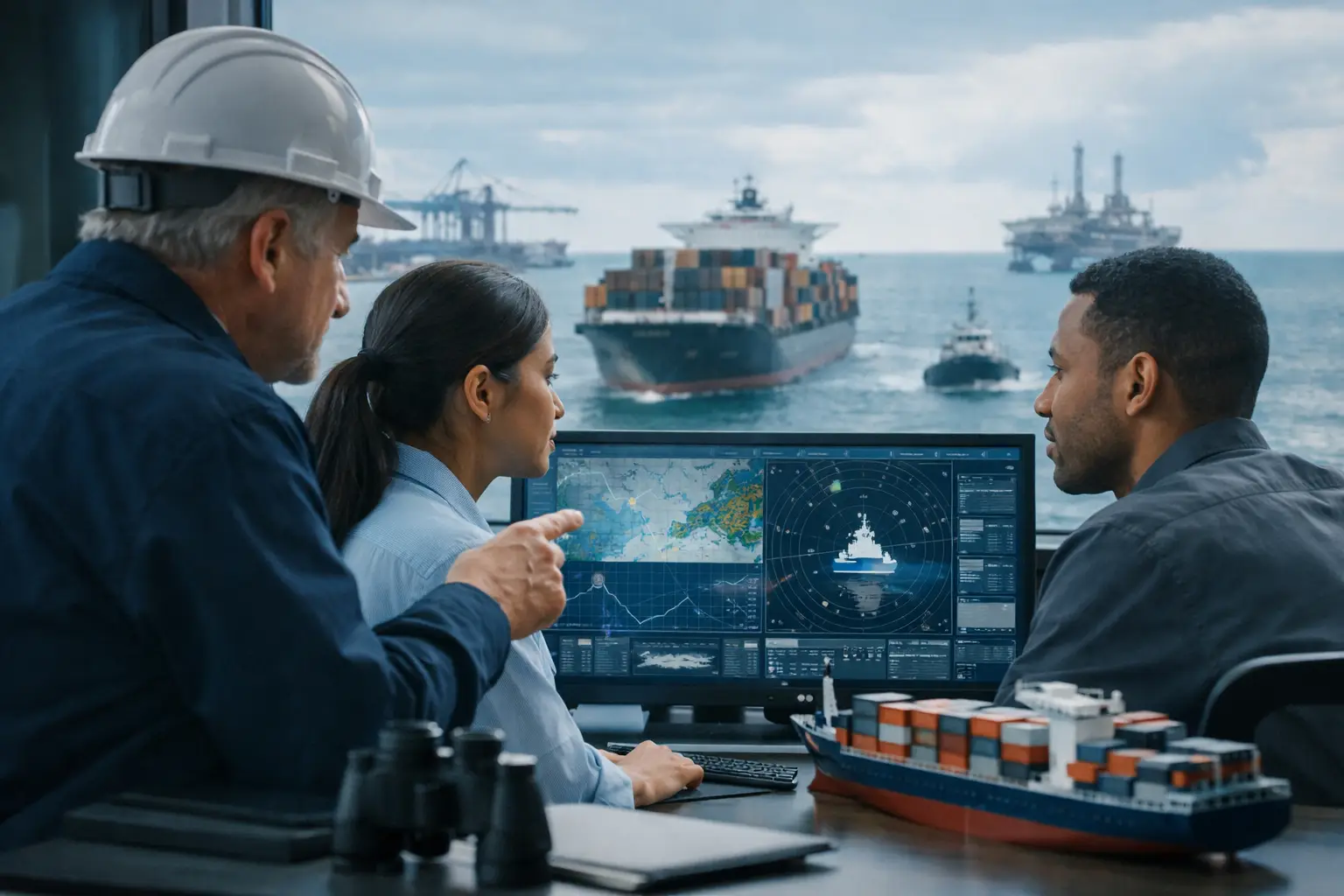
Guide to maritime risk management should help maritime leaders, crew, and shore-based teams identify operational risks, apply proportionate controls, and make better safety, compliance, and commercial decisions under pressure.
A vessel can be fully compliant on paper and still be exposed where it matters most: in daily decisions, handovers, maintenance delays, contractor oversight, and changing operating conditions. That is why a guide to maritime risk management should do more than define risk categories. It should help leaders, crew, and shore-based teams make better judgements under pressure.
Maritime operations bring together technical complexity, environmental exposure, regulatory scrutiny, and human factors in a way few industries do. A single voyage can involve cargo risk, weather risk, cyber risk, fatigue, port-state requirements, and commercial pressures at the same time. Effective risk management is not a separate administrative exercise. It is part of how safe, compliant, and commercially sound operations are sustained.
What Maritime Risk Management Actually Covers
At its core, maritime risk management is the structured process of identifying what could go wrong, estimating the likelihood and impact, putting controls in place, and reviewing whether those controls still work in practice. In shipping, that sounds straightforward until real-world conditions interfere.
The International Maritime Organization explains that the International Safety Management Code provides an international standard for the safe management and operation of ships and pollution prevention. This makes it a useful foundation for any guide to maritime risk management, because effective risk control depends on both documented systems and practical safety management. Read IMO’s overview of the ISM Code.
A risk that appears low in one context can become significant in another. Bunkering in calm weather with an experienced crew is not the same as bunkering during a tight turnaround with contractor changes and communication gaps. Container securing on a routine route is different when severe weather patterns shift unexpectedly. The same activity can carry different levels of risk depending on timing, competence, equipment condition, and operational pressure.
This is why strong maritime risk management depends on context, not just checklists. Procedures matter, but so does the ability to recognise when conditions have changed enough to require a fresh assessment.
A Guide to Maritime Risk Management in Practice
The most useful approach is a repeatable one. Teams need a system that works at sea, in port, and across shore support functions. That usually begins with identifying risk across five broad areas: safety of personnel, vessel integrity, cargo protection, environmental exposure, and business continuity.
For example, a machinery failure is not only a technical issue. It can create collision risk, pollution risk, schedule disruption, contractual consequences, and reputational damage. A cyber incident is not only an IT concern. It can affect navigation, communications, cargo documentation, and terminal coordination. Looking at risk through a wider operational lens helps organisations avoid narrow assessments that miss downstream effects.
The next step is evaluation. Many operators use a risk matrix, but the matrix is only as good as the judgement behind it. If teams routinely underrate familiar hazards because they have not caused a recent incident, the tool becomes misleading. If they overrate every issue, priority-setting becomes impossible. Good evaluation depends on evidence, operational experience, and honest reporting.
Controls should then be selected in order of effectiveness. Eliminating a hazard is stronger than relying on a warning notice. Engineering controls are usually more dependable than administrative reminders alone. Training is essential, but training without supervision, maintenance, and accountability rarely closes the gap. In maritime settings, layered controls are often necessary because no single measure is fully reliable in isolation.
Review is where many systems weaken. Risk assessments are often completed, filed, and rarely revisited unless an incident forces attention. A stronger model treats review as continuous. Near misses, inspection findings, equipment trends, crew feedback, route changes, and regulatory updates should all trigger reassessment.
A practical guide to maritime risk management therefore needs to support a full cycle: identify, evaluate, control, monitor and review. The value is not in completing the form. It is in improving the quality of operational decisions.
The Risks That Deserve the Closest Attention
Not every risk carries the same operational weight. Some are high-frequency and manageable, such as slips, trips, or routine equipment faults. Others are lower-frequency but potentially catastrophic, such as fire, grounding, collision, enclosed space incidents, cargo instability, or pollution events. Mature risk management systems address both.
Human factors deserve particular attention because they often sit behind technical failures. Fatigue, language barriers, weak safety culture, poor supervision, unclear authority, and rushed decision-making can reduce the value of otherwise sound procedures. When incident investigations identify human error, that should not end the analysis. The more useful question is what conditions made the error more likely.
Cyber risk now belongs in the same conversation as physical safety. Modern vessels and shipping operations depend on connected systems for navigation, cargo management, communications, and administration. That creates efficiency, but it also expands exposure. Phishing, weak access controls, outdated software, and vendor vulnerabilities can affect operational resilience just as seriously as mechanical failures.
Climate and environmental pressures are also changing the risk picture. More volatile weather patterns, tighter emissions requirements, and increasing scrutiny around pollution prevention mean operators must plan for both compliance and disruption. In practice, this requires scenario-based thinking rather than reliance on historical norms alone.
A strong guide to maritime risk management should therefore include safety, technical, cyber, environmental, human-factor and business-continuity risks. These risks are connected in practice, even when they are managed by different teams.
Building a Risk Management Process Crews Will Actually Use
The best framework is the one people can apply consistently in real operating conditions. If forms are too complex, if reporting creates blame, or if the process slows down urgent decisions without adding clarity, compliance will become superficial.
A workable system starts with clear risk ownership. Masters, officers, engineers, shore managers, technical teams, and contractors all influence risk, but not in the same way. Ambiguity creates gaps. Teams need to know who assesses, who authorises, who monitors, and who escalates when conditions move outside agreed limits.
Training also needs to go beyond policy awareness. People should be able to recognise early warning signs, apply risk tools correctly, and make trade-off decisions when time, cost, and safety pressures collide. This is where case-based learning adds real value. Reviewing realistic incidents, operational dilemmas, and near misses helps professionals understand how risk develops before it becomes visible in a formal report.
Documentation still matters, especially for auditability and regulatory alignment, but the standard should be useful evidence, not paperwork volume. A concise, accurate assessment tied to actual controls is more valuable than a detailed document copied from a previous operation.
This is why a practical guide to maritime risk management should be designed around usability. If crews and shore teams cannot apply the process during real operations, the system will look compliant but remain weak in practice.
Leadership, Culture, and the Quality of Escalation
Risk management quality usually reflects leadership quality. Where crews believe operational concerns will be dismissed, delayed, or penalised, weak signals stay hidden. Where reporting is encouraged and acted upon, small issues are more likely to be resolved before they escalate.
That does not mean every reported hazard requires the same response. It means concerns are evaluated seriously, feedback loops are visible, and lessons are shared. People support systems they trust. They bypass systems they see as symbolic.
Escalation is especially important in maritime operations because conditions can deteriorate quickly. Teams should know what triggers a pause, what requires shore consultation, and what decisions remain onboard. Over-centralisation can slow urgent action. Under-support from shore can leave vessel teams isolated. The balance depends on the nature of the operation, vessel type, and the competence available at the point of decision.
A useful guide to maritime risk management should therefore treat leadership and culture as part of risk control. Procedures may define expectations, but leadership behaviour determines whether people report, escalate and act before a risk becomes an incident.
Measuring Whether Your Controls Are Working
A common mistake is to judge risk management only by the absence of major incidents. That can create false confidence. Stronger indicators include the quality of near-miss reporting, closure rates for corrective actions, repeat findings, maintenance backlog trends, permit compliance, drill performance, inspection outcomes, and whether lessons learned are being applied across the fleet.
These measures should be interpreted carefully. A rise in reported near misses may reflect deterioration, but it may also indicate a healthier reporting culture. A low incident count may reflect effective controls, or it may reflect underreporting. Numbers matter, but context matters more.
For managers, this is where regular review meetings become useful if they focus on decision quality rather than blame. What changed? Which assumptions proved wrong? Where are controls becoming routine rather than thoughtful? Those questions often reveal more than broad performance summaries.
This is an important part of any guide to maritime risk management. Risk controls should not be assumed effective simply because they exist. They need to be reviewed, tested, challenged and improved based on evidence from operations.
Compliance Matters, But It Is Not the Finish Line
Maritime regulations, class requirements, and company procedures provide essential structure. They create minimum expectations and common standards. But compliance alone does not guarantee control of risk. It is possible to meet formal requirements while missing practical vulnerabilities in execution.
The stronger view is to treat compliance as the baseline and operational learning as the differentiator. Organisations that improve over time tend to test assumptions, learn from weak signals, and update controls before a serious event forces change. They build competence, not just documentation.
For professionals developing capability in this area, that distinction matters. Risk management is not only about satisfying audits. It is about improving judgement across vessel operations, technical management, safety oversight, and commercial planning. The more connected those functions become, the more resilient the operation becomes.
In maritime settings, risk can never be removed completely. Weather changes, systems fail, and people work under constraints. The goal is not perfection. It is disciplined awareness, better decisions, and a culture where warning signs are recognised early enough to act on them.
That is the real value of a guide to maritime risk management. It helps maritime professionals move from paperwork compliance to practical risk control, where safety, judgement, accountability and operational resilience work together.
Recommended The Case HQ Courses for Maritime Risk and Safety Capability
If you want practical, self-paced learning in maritime risk, safety, compliance and leadership, these The Case HQ courses are especially relevant:
- Maritime Risk Management Training
- Maritime Safety Training Online
- Shipping Compliance Training
- Maritime Leadership Training
- AI in Maritime: What Leaders Must Know
- Certified Project Risk and Controls Professional
- Certified Strategic Project Leader (CSPL)
Further Reading on Maritime Safety, Compliance and Professional Learning
To continue building practical maritime and operational capability, you may also find these The Case HQ blog resources useful:
Responses