

The world of work is evolving faster than ever. By 2030, millions of jobs will look nothing like they do today, with artificial intelligence, sustainability, and global collaboration reshaping every industry. That’s why professionals, students, and lifelong learners are asking: What to Study in 2025 to stay relevant in 2030?
This guide explores the most in-demand fields of study, why they matter, and how you can future-proof your career.
Why Asking “What to Study in 2025” Matters
- AI-driven disruption – By 2030, over 40% of current job roles will be reshaped by AI and automation.
- Sustainability imperative – Green skills and climate-focused jobs are exploding in demand.
- Global uncertainty – Geopolitics, supply chains, and pandemics highlight the need for resilience.
- Lifelong learning – Degrees alone are not enough; micro-credentials and certifications are rising.
Choosing what to study in 2025 isn’t about chasing trends, it’s about building adaptable skills that last a decade or more.
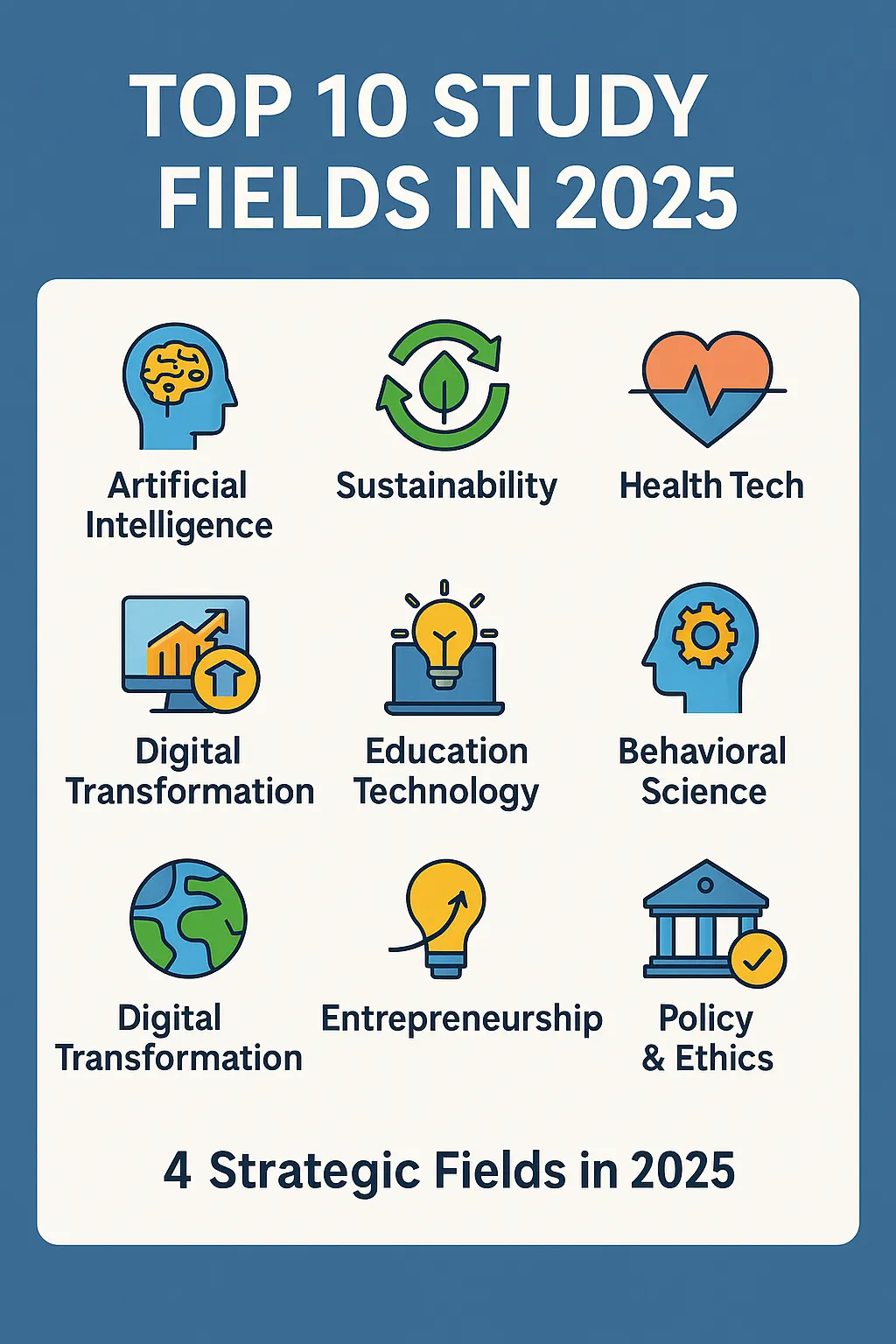
What to Study in 2025: The Top 10 Future-Proof Fields
1. Artificial Intelligence & Data Science
AI will be at the center of business, healthcare, and governance.
- Skills: Machine learning, prompt engineering, AI ethics.
- Careers: AI strategist, data scientist, AI ethicist.
2. Sustainability & Climate Studies
With climate targets set for 2030, sustainability is a non-negotiable.
- Skills: ESG reporting, green finance, renewable energy management.
- Careers: Sustainability officer, environmental analyst, climate consultant.
3. Cybersecurity & Digital Safety
Cyber threats grow as AI advances.
- Skills: Threat analysis, ethical hacking, cyber law.
- Careers: Cybersecurity analyst, digital risk consultant, AI security expert.
4. Health Tech & Bioinformatics
Healthcare will be transformed by AI, genomics, and telemedicine.
- Skills: Data analytics in healthcare, bioinformatics, patient-centered AI.
- Careers: Health data scientist, bioinformatics specialist, telehealth manager.
5. Global Business & Geopolitics
Understanding interconnected markets is essential.
- Skills: Cross-cultural leadership, international trade, global strategy.
- Careers: International business consultant, policy advisor, global strategist.
6. Digital Transformation & Innovation
All industries require leaders who can manage tech-driven change.
- Skills: Change management, digital tools integration, innovation strategy.
- Careers: Digital transformation manager, innovation strategist.
7. Education Technology & Learning Sciences
Education is being reinvented through AI and immersive tech.
- Skills: Instructional design, AI-driven learning, VR/AR in education.
- Careers: Learning experience designer, EdTech consultant.
8. Behavioral Science & Psychology
As automation grows, human skills become more valuable.
- Skills: Organizational psychology, decision science, behavior design.
- Careers: Behavioral economist, workplace psychologist, UX researcher.
9. Entrepreneurship & Startup Skills
By 2030, many professionals will run side businesses or startups.
- Skills: Lean startup methods, AI-powered business design, fundraising.
- Careers: Founder, business strategist, innovation coach.
10. Governance, Policy & AI Ethics
Regulation of AI and tech will be a dominant issue.
- Skills: Policy analysis, compliance, AI governance frameworks.
- Careers: AI ethics officer, regulatory consultant.
What to Study in 2025: The Hybrid Skills Employers Want
Beyond disciplines, employers are seeking hybrid skillsets:
- AI + Industry Knowledge – Example: AI in law, AI in healthcare.
- Tech + Communication – Example: Data storytelling, AI-powered marketing.
- Sustainability + Finance – Example: Green investments, carbon credit markets.
- Leadership + Digital Agility – Example: Leading remote and hybrid teams with AI
Case Study: The “Future-Ready Professional”
Amira, a marketing manager in 2025, noticed AI was reshaping her role. Instead of resisting, she studied AI in Digital Marketing through a micro-credential program. By 2030, she had transitioned into a Chief AI Marketing Strategist, leading teams globally.
Her story illustrates why asking What to Study in 2025 is a career-defining question.
How to Decide What to Study in 2025
- Align with passion + market demand – Find overlap between interests and growth areas.
- Start with micro-credentials – Quick, stackable learning to test interest.
- Build interdisciplinary depth – Blend AI, sustainability, and human skills.
- Stay adaptive – Refresh learning every 12–18 months.
Conclusion: Your 2025 Study Choices Shape 2030
The answer to What to Study in 2025 isn’t a single degree or certificate. It’s a mindset: combining future-proof fields like AI, sustainability, and health tech with adaptable human skills like strategic thinking and creativity.
By investing in the right skills today, you won’t just stay relevant in 2030, you’ll be leading the future of work.
Visit our other human resource certifications
Visit our other artificial intelligence certifications
Visit our other digital technology certifications
Visit our other higher education certifications
Visit our other quality and lean six sigma certifications
Visit our other strategy and management certifications
Read more:
How to Upskill in AI Without a Technical Background
Why Microcredentials Are the Future of Professional Growth
Best Practices for Building AI-Supported Marking Schemes
Should Rubrics Be Machine-Interpretable? The Debate
Multi-Dimensional Rubrics Powered by AI Insights
Using Gen AI to Simplify Complex Rubrics
Responses