

In a marketplace defined by rapid innovation, heightened customer expectations, and relentless competition, organisations can no longer afford to rely on trial-and-error approaches to design. Products and services must perform flawlessly from the outset, align precisely with customer needs, and deliver consistent value across their lifecycle. Design for Six Sigma (DFSS) provides a disciplined, data-driven methodology to achieve exactly that.
This course has been carefully developed to equip professionals with the capability to design solutions that are not only innovative but also reliable, scalable, and customer-focused. It moves beyond theory, offering a practical framework that empowers you to make confident, evidence-based design decisions from concept through to implementation.
Why Design for Six Sigma is a Strategic Advantage
Traditional quality approaches often focus on identifying and fixing defects after they occur. While effective for continuous improvement, this reactive model can be costly, time-consuming, and limiting in fast-paced environments. DFSS takes a fundamentally different approach—preventing problems before they arise by embedding quality directly into the design process.
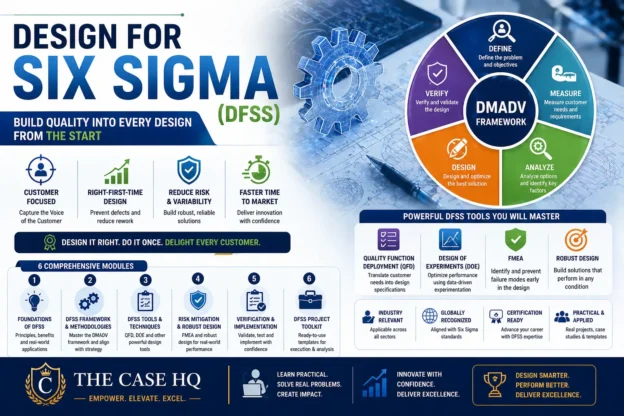
At the heart of DFSS lies a commitment to right-first-time design. By systematically capturing customer expectations, translating them into measurable requirements, and validating solutions early, organisations can significantly reduce rework, accelerate development timelines, and improve overall performance.
Adopting DFSS enables organisations to:
- Deliver products and services that consistently meet or exceed customer expectations
- Reduce costly late-stage design changes and operational inefficiencies
- Improve collaboration across multidisciplinary teams
- Strengthen decision-making through data and structured analysis
- Enhance long-term competitiveness through quality-driven innovation
For professionals, mastering DFSS means gaining a highly valued skill set that bridges engineering, quality, and strategic thinking.
A Practical, Industry-Relevant Learning Experience
This course has been designed with a clear emphasis on application. Rather than presenting DFSS as a purely theoretical concept, it guides you through how the methodology is used in real organisational contexts. You will explore how leading organisations design solutions that are robust, efficient, and aligned with customer needs—before they ever reach the market.
Through carefully structured lessons, you will develop a deep understanding of how to:
- Identify and interpret the Voice of the Customer (VoC)
- Translate customer insights into clear design specifications
- Evaluate design alternatives using analytical tools
- Anticipate and mitigate risks before they materialise
- Validate and refine solutions through structured testing
Each concept is supported by practical examples and guided exercises, ensuring that learning is immediately transferable to your professional environment.
Learn the Tools That Drive High-Quality Design
A defining strength of DFSS lies in its use of proven analytical and decision-making tools. This course introduces you to the most widely used techniques in a clear and accessible manner, enabling you to apply them with confidence.
You will gain hands-on familiarity with tools such as:
- Quality Function Deployment (QFD) for translating customer needs into engineering characteristics
- Voice of the Customer (VoC) methods for capturing and structuring user expectations
- Failure Mode and Effects Analysis (FMEA) for identifying and prioritising potential risks
- Design of Experiments (DOE) for optimising performance through controlled testing
These tools are not presented in isolation; instead, you will learn how they integrate within a cohesive design framework, supporting informed and effective decision-making at every stage.
Designed for Immediate Workplace Application
One of the key strengths of this course is its focus on real-world usability. Every concept, tool, and framework is presented with practical implementation in mind. You will not only understand what DFSS is, but also how to apply it in your own projects and organisational context.
The course includes:
- Realistic case-based scenarios drawn from multiple industries
- Structured exercises that simulate design challenges
- Downloadable templates and worksheets for immediate use
- Step-by-step guidance on applying DFSS in live projects
This ensures that you can transition seamlessly from learning to application, adding value to your organisation from the outset.
Who This Course is For
This course is designed for professionals who are involved in designing, developing, or delivering products and services, as well as those seeking to enhance their capability in quality-driven innovation.
It is particularly valuable for:
- Engineers and product developers looking to strengthen design quality
- Project managers responsible for delivering complex initiatives
- Quality professionals seeking to adopt a proactive design approach
- Six Sigma practitioners expanding into advanced methodologies
- Innovation leaders driving new product or service development
- Entrepreneurs and start-ups aiming to build scalable, high-quality solutions
No matter your industry—whether manufacturing, healthcare, technology, or services—the principles of DFSS are universally applicable and highly transferable.
What You Will Be Able to Do
By completing this course, you will develop a robust and practical skill set that enables you to approach design challenges with clarity and confidence. You will be able to:
- Design products and services that align closely with customer expectations
- Make informed decisions using data and structured methodologies
- Identify potential risks early and implement preventative measures
- Improve efficiency by reducing redesign cycles and development delays
- Contribute effectively to cross-functional teams and complex projects
- Apply DFSS principles within broader organisational strategies
These capabilities are increasingly in demand across industries, making DFSS a valuable addition to your professional expertise.
Supporting Modern Ways of Working
Organisations today operate within dynamic environments where speed, adaptability, and quality must coexist. DFSS integrates effectively with modern frameworks such as Lean, Agile, and digital transformation initiatives.
Rather than slowing down innovation, DFSS enhances it by providing structure and clarity. It enables teams to move quickly while maintaining high standards of quality and reliability. This balance is critical in ensuring that innovation efforts translate into sustainable success.
A Valuable Investment in Your Professional Growth
Developing expertise in Design for Six Sigma is more than a technical achievement—it is a strategic investment in your career. Professionals who can design solutions that are both innovative and reliable are highly sought after, particularly in roles that require cross-functional collaboration and decision-making.
This course equips you with:
- A recognised and respected methodology used globally
- Practical tools that can be applied across multiple industries
- The ability to lead or contribute to high-impact design initiatives
- A deeper understanding of how to align design with business objectives
Whether you are advancing in your current role or preparing for new opportunities, DFSS provides a strong foundation for long-term professional success.
Why Choose This Course
There are many introductions to Six Sigma available, but this course distinguishes itself through its focus on design excellence, practical application, and real-world relevance. It has been developed to ensure that learners not only understand DFSS but can use it effectively in their own professional contexts.
Key strengths include:
- Clear, structured learning aligned with industry practices
- Emphasis on practical application rather than abstract theory
- Inclusion of tools, templates, and guided exercises
- Relevance across a wide range of sectors and roles
- Focus on building confidence in real-world decision-making
Begin Your DFSS Journey
Design for Six Sigma represents a shift in mindset—from fixing problems to preventing them, from reacting to anticipating, and from incremental improvement to purposeful design excellence.
By enrolling in this course, you will gain the knowledge and tools to design solutions that deliver value from the very beginning. You will be equipped to approach challenges with a structured, analytical perspective and to contribute meaningfully to innovation within your organisation.
If you are ready to move beyond reactive quality management and embrace a proactive, design-led approach to excellence, this course provides the ideal starting point.
Visit our website for latest courses: https://thecasehq.com/
Visit our AI Courses: https://thecasehq.com/artificial-intelligence-courses/
Visit our Digital Technology Courses: https://thecasehq.com/digital-technologies/
Visit our Higher Education Courses: https://thecasehq.com/higher-education-courses/
Visit our Quality and Lean Six Sigma Courses: https://thecasehq.com/quality-lean/
Visit our Strategy and Leadership Courses: https://thecasehq.com/strategy-and-management-courses/
Visit our Human Resource Courses: https://thecasehq.com/human-resources/
Visit our Maritime and Shipping Courses: https://thecasehq.com/maritime-shipping/
Last updated: April 2026
Course Content
Module 1: Introduction to Design for Six Sigma
Course Includes
- 28 Lessons
- 1 Quiz
- Course Certificate
