

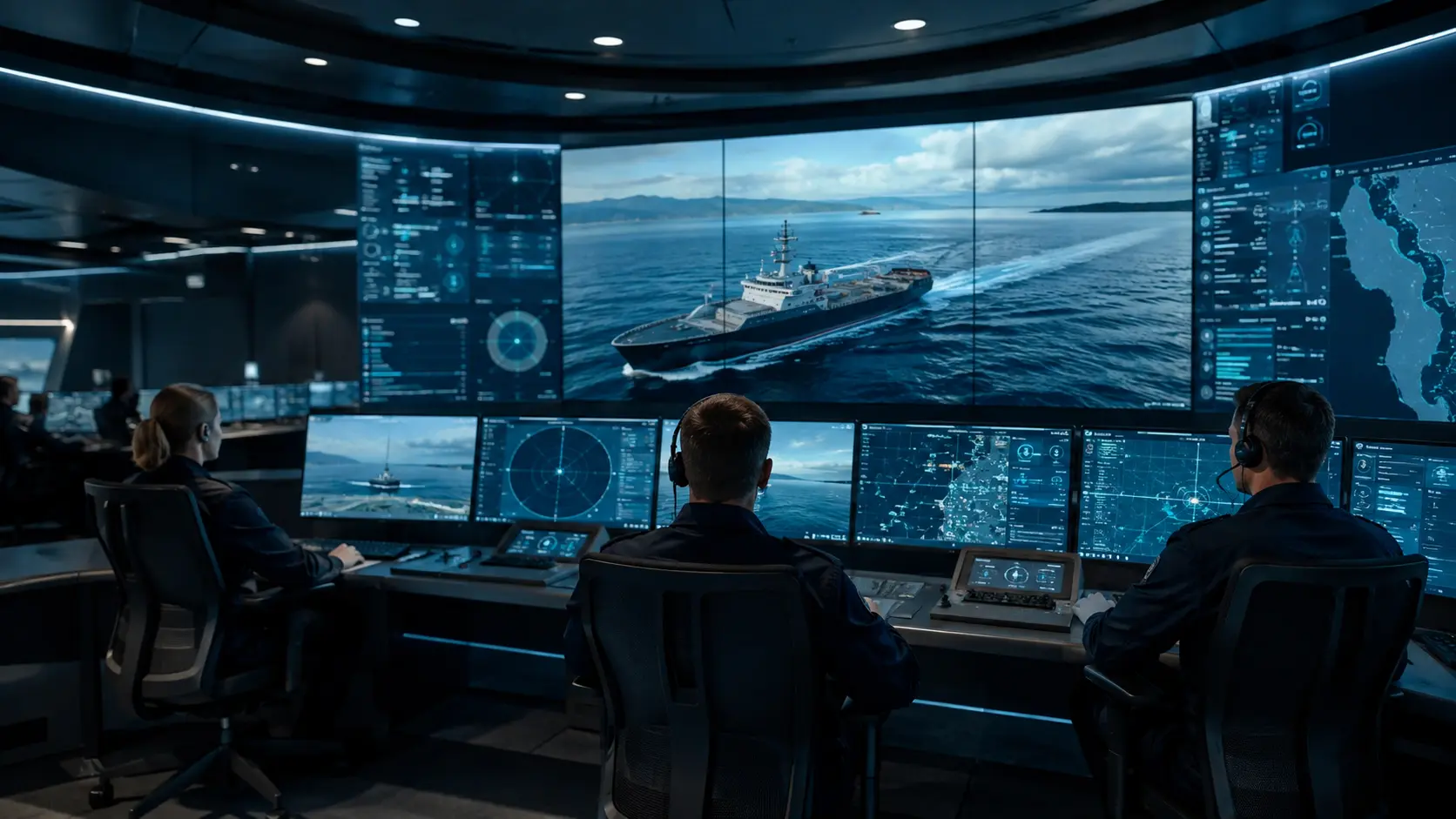
When ship functions move from bridge to shore, responsibility does not disappear. It changes location, interfaces and failure modes.
The IMO’s non-mandatory MASS Code, effective from 1 July 2026, brings remote operations centres (ROCs) into the autonomous-shipping safety framework. That makes an ROC more than an office full of screens. Where it performs safety-relevant functions, its people, systems, communications and authority need to be governed as part of the operating concept.
Start with the authority map
Document who can monitor, advise, intervene, assume control and return control. Include the master or onboard personnel where present, remote operators, technical support and emergency authorities.
For each operating mode, answer one question: who has final authority right now?
The Certified Maritime Governance Professional is relevant for leaders building governance that connects board-level accountability to new operating structures.
Define the handover, not only normal operation
The dangerous moment may be the transition. Specify conditions for vessel-to-ROC handover, ROC-to-vessel return, operator changeover and transfer between ROCs.
Test what information must be shared, how both sides confirm control and what happens if the handover is incomplete.
Build competence around the actual function
Remote operators may need navigation, engineering, systems, communications and emergency competencies in different combinations. Do not assume conventional seagoing competence transfers automatically to a multi-vessel shore environment.
Use scenario assessment: conflicting alarms, degraded sensors, communications loss, operator workload and simultaneous events.
Treat connectivity as a safety dependency
Map primary and backup communications, latency tolerances, coverage gaps and minimum data required for safe operation. Define what the vessel does when connectivity degrades.
Safe degraded behaviour should be designed before failure, not improvised during it.
The Certified Maritime Risk Management Professional can support teams assessing these new interdependencies systematically.
Control workload and situational awareness
An ROC may supervise more than one vessel. That creates a human-factors question: how many complex events can one operator manage safely?
Do not set staffing ratios only from quiet operations. Stress-test peak workload, alarm floods, handovers and abnormal conditions. EMSA research into shore control centres and remote operation provides useful evidence for this developing operational area.
Make cyber resilience operational
A cyber incident can become a navigation or control problem. Segment critical systems, manage privileged access, monitor connections and define how the ROC and vessel continue safely when digital trust is uncertain.
Cyber drills should involve operators, not only IT teams.
Use a six-part ROC readiness test
Before operational approval, require evidence for:
- authority in every operating mode;
- competence and fatigue controls;
- normal and emergency handover;
- communication degradation and loss;
- cyber incident and fallback; and
- logging sufficient to reconstruct decisions.
The AI in Maritime: What Leaders Must Know course provides a broader leadership context for organisations integrating AI and autonomy into maritime operations.
Separate operator support from autonomous authority
An ROC may use AI for anomaly detection, route options or alert prioritisation without delegating control authority to the AI. Document which functions are advisory and which can actuate vessel systems.
For every automated action, specify operating limits, override, logging and safe state. Avoid letting a decision-support feature acquire operational authority simply because integration makes it technically possible.
Audit the full ROC dependency chain
Include power, cooling, physical security, staffing, communications providers, cloud services, data feeds and software vendors. A remote centre can be operationally critical even when each individual dependency appears ordinary.
Test loss of the ROC itself: where does control go, which vessels are affected and how is traffic or coastal authority informed where necessary?
A practical scenario: communications degradation
Imagine an ROC supervising a remotely operated vessel when bandwidth falls below the level required for stable video and control feedback. The system still receives basic telemetry.
A mature operating concept does not ask the remote operator to decide from scratch. It defines the minimum link for each function, the vessel’s fallback behaviour, the authority to change mode, how nearby traffic is considered and when emergency support is activated.
The test of governance is whether the safe response is known before the link deteriorates.
Final takeaway
Remote operations centre governance should be designed as part of the maritime safety system. Define authority, transitions, competence, workload, connectivity, cyber resilience and evidence together.
Autonomous shipping changes where decisions happen. It does not reduce the need to know who is accountable for them.
Responses