

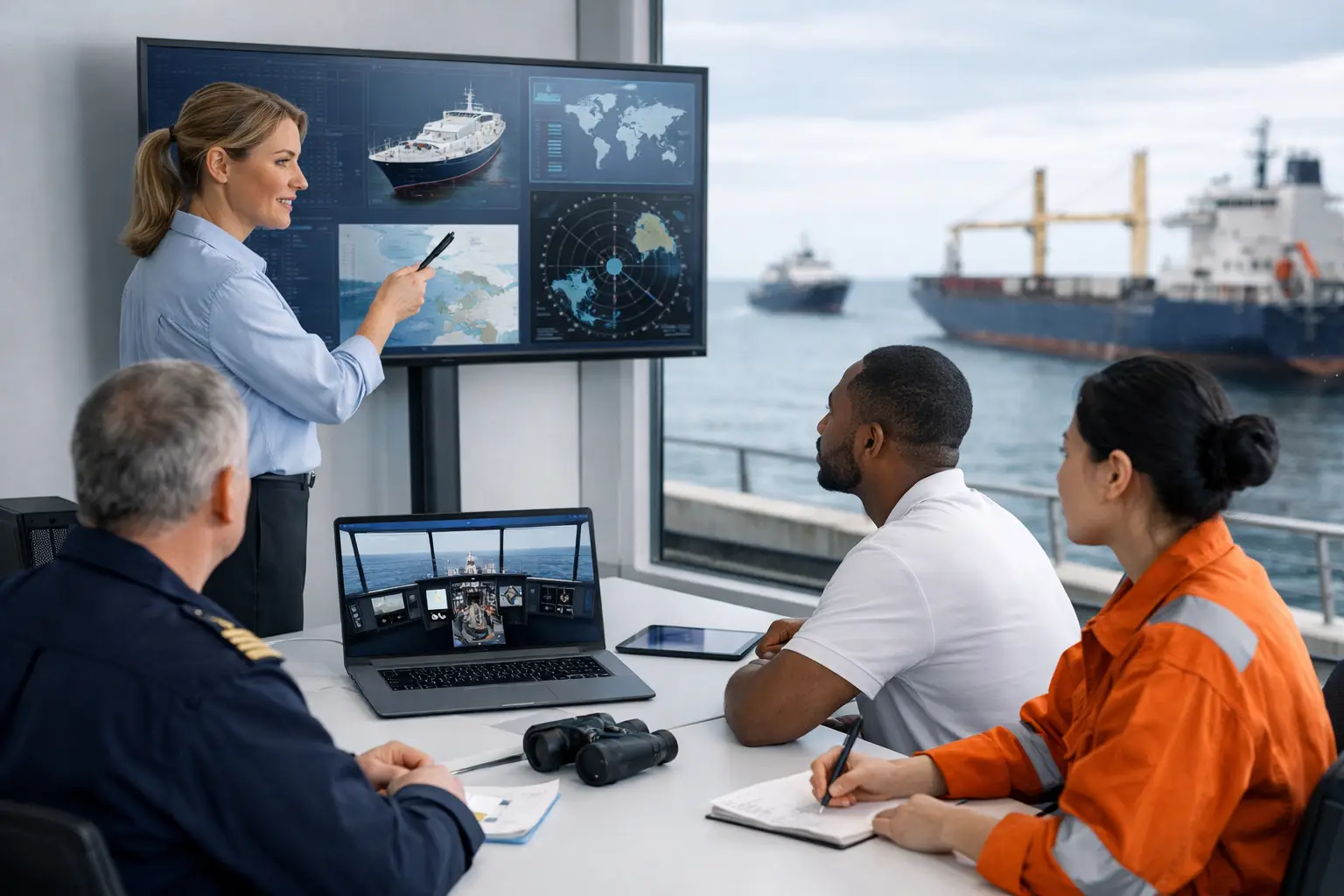
Maritime compliance training guide planning should help teams move beyond basic completion records and build the judgement, documentation habits, and decision-making capability needed in real maritime operations.
A failed inspection rarely comes down to one dramatic mistake. More often, it traces back to routine gaps: a crew member who did not understand a reporting duty, a manager who treated training as a one-time event, or records that looked complete until an auditor asked harder questions. That is why a strong maritime compliance training guide matters. In shipping and maritime operations, compliance is not only about passing reviews. It is about building reliable judgement in environments where legal duties, operational pressure, and safety risks meet every day.
What a Maritime Compliance Training Guide Should Actually Do
Many organisations already provide some form of compliance instruction. The problem is that training can become too broad, too generic, or too detached from how work is really carried out onboard and ashore. A useful maritime compliance training guide should do more than list topics such as safety, environmental rules, anti-bribery, labour standards, and documentation procedures. It should help leaders decide what people need to know, when they need to know it, and how competence will be demonstrated in practice.
That distinction matters. Completion is not the same as capability. A crew member may finish a module on pollution prevention, for example, yet still hesitate when facing an actual reporting decision under time pressure. A port operations manager may understand sanctions rules in principle but struggle to apply them when vessel schedules, customer expectations, and incomplete documentation collide. Effective compliance training closes that gap between formal knowledge and operational action.
A practical maritime compliance training guide should therefore connect training content to real duties, risk exposure, documentation standards, escalation procedures, and decision-making expectations.
Why Maritime Compliance Training Is More Complex Than Standard Corporate Training
Shipping operates across jurisdictions, regulators, flags, ports, charter requirements, and internal company controls. The result is a layered compliance environment where obligations overlap and sometimes shift faster than training materials do. A maritime compliance training guide needs to recognise that complexity rather than flatten it into a simple checklist.
The International Maritime Organization’s International Safety Management Code provides an international standard for the safe management and operation of ships and for pollution prevention. This reinforces why maritime compliance training should not be treated as a generic corporate learning activity. It must support safe operations, pollution prevention, accountability, and management systems in practical maritime contexts.
There is also a practical challenge that other sectors do not face in the same way. Learners may be distributed across vessels, offices, and time zones, with varying connectivity and limited time for extended classroom sessions. Some employees need detailed instruction on specific procedures, while others need enough understanding to supervise, escalate concerns, and make sound decisions. One programme will not fit every role.
This is where structured, case-based learning has a clear advantage. When training uses realistic scenarios, people can test their understanding against the kinds of ambiguity they will face in the field. They are not only memorising a rule. They are learning how to respond when facts are incomplete, authority lines are blurred, or commercial pressure is high.
Start with a Risk-Based Training Map
Before creating or buying content, define the compliance risks that matter most to your operation. That sounds obvious, but many organisations start at the course catalogue stage instead of the risk stage. The better approach is to map training needs against your actual exposure.
For one company, the immediate priority may be environmental compliance and incident reporting. For another, it may be trade compliance, crew welfare obligations, or document control under audit scrutiny. The right training map usually reflects several variables at once: vessel type, routes, cargo profile, customer requirements, regulatory exposure, and the responsibilities of both onboard and shore-based teams.
A good map also distinguishes between awareness, working knowledge, and decision authority. Senior leaders do not need the same level of procedural detail as frontline operators, but they do need enough understanding to resource compliance properly and challenge weak practices. Likewise, not every learner needs advanced depth on every regulation. Overloading people with irrelevant content often reduces retention rather than improving it.
This is one of the most important principles in any maritime compliance training guide. Training should be risk-based, role-specific, and connected to actual operational responsibility.
Core Areas Most Programmes Need to Cover
The exact curriculum will depend on your operation, but most maritime compliance training frameworks need to address safety management responsibilities, environmental obligations, reporting and recordkeeping, ethics and anti-corruption, labour and conduct standards, inspection readiness, and escalation procedures. Cybersecurity increasingly belongs in this mix as well, especially where operational systems and administrative processes intersect.
The key is not to treat these as isolated topics. In practice, they interact. A reporting failure can become an environmental issue, a documentation issue, and a leadership issue at the same time. Training should reflect that operational reality.
A strong maritime compliance training guide should also clarify which topics require awareness only, which require practical application, and which require formal assessment or supervisor verification. This helps avoid the common problem of giving everyone the same content while failing to build the capability each role actually needs.
Build Training Around Decisions, Not Just Regulations
One of the most common weaknesses in compliance education is a regulation-first structure that asks learners to absorb requirements without understanding the decisions those requirements shape. A stronger maritime compliance training guide organises learning around moments that matter.
Consider a few examples. What should a master or officer do when an internal procedure appears to conflict with immediate operational conditions? How should an operations team respond when a third-party request creates potential sanctions exposure? What happens when a near miss is reported informally but not entered into the formal system? These are not abstract questions. They sit at the heart of compliance performance.
This is why practical exercises are so valuable. Scenario analysis, incident reviews, and structured case discussions help learners move from recognition to judgement. They also reveal where policies are unclear or where managers have assumed understanding that does not actually exist.
Training built around decisions is usually more effective because it reflects how compliance problems appear in real life. People rarely face a regulation in isolation. They face a situation, pressure, incomplete information, and a need to act correctly.
Case-Based Learning Improves Retention
Adults learn best when material is clearly relevant to their responsibilities. In compliance training, that means presenting realistic dilemmas, competing priorities, and documented consequences. A case-based method gives learners a framework for interpretation, not just recall.
For professional education providers such as The Case HQ, this approach is especially relevant because it aligns learning with workplace decision-making. It helps managers and specialists understand not only what the rule says, but how to apply it consistently and defensibly.
This is why a maritime compliance training guide should include case studies, incident examples, decision prompts, and reflection questions. These methods help learners practise the judgement they need before they face a real inspection, audit, incident, or escalation decision.
Documentation Matters as Much as Delivery
Even well-designed training can fail under scrutiny if records are inconsistent or incomplete. In maritime settings, compliance evidence often matters almost as much as compliance intent. Auditors, clients, regulators, and internal reviewers will want to see who was trained, when training took place, what was covered, how comprehension was assessed, and whether refresher cycles are enforced.
This does not mean building a bureaucratic archive for its own sake. It means making training traceable and useful. Certificates, completion logs, assessment results, version-controlled materials, and role-based training matrices all help demonstrate a managed approach. They also make it easier to identify gaps before an external review does.
There is a trade-off here. Organisations sometimes respond to documentation pressure by prioritising administrative completion over meaningful learning. That usually creates a false sense of security. The better balance is to treat records as evidence of a living system, not as a substitute for one.
A practical maritime compliance training guide should therefore explain how training evidence will be stored, reviewed, updated, and used to identify risk. Documentation should support compliance capability, not replace it.
How Often Should Maritime Compliance Training Be Updated?
It depends on the topic, the pace of regulatory change, and the operational risk involved. Annual refresher cycles may be reasonable for some core subjects, but high-risk areas may need more frequent updates, especially after incidents, procedural changes, or new legal guidance. New joiners need structured onboarding, and role changes should trigger targeted retraining rather than waiting for the next broad cycle.
Update frequency also depends on whether your current programme is producing reliable outcomes. If repeated audit findings point to the same misunderstanding, the issue may not be learner memory. It may be poor course design, weak managerial reinforcement, or a mismatch between the policy and actual workflow.
This means a maritime compliance training guide should not only set a training calendar. It should create rules for when training must be reviewed. Triggers may include new regulations, audit findings, incident trends, route changes, vessel changes, technology changes, customer requirements, or revised company procedures.
Signs Your Current Programme Needs Work
If training is treated as a compliance event instead of an operational discipline, warning signs tend to appear quickly. People complete modules but cannot explain what escalation route to use. Supervisors sign off on competence without observing performance. Policies are available, but teams rely on informal workarounds. Audit findings recur in slightly different forms. Near misses are discussed locally but do not feed into revised learning content.
These patterns suggest a system that is technically active but strategically weak. A stronger maritime compliance training guide creates feedback loops. Incident data should inform future training. Audit themes should shape refreshers. Managers should be accountable not only for attendance, but for whether standards are actually being followed.
Another warning sign is training that looks complete on paper but does not change behaviour. If people pass short quizzes but still struggle with reporting, documentation, escalation, or inspection readiness, the training may be too passive. Compliance learning should build action capability, not only awareness.
Choosing the Right Maritime Compliance Training Model
There is no single best format for every maritime organisation. Self-paced online learning works well for distributed teams and for foundational consistency across locations. It gives professionals flexibility and helps organisations standardise core knowledge. But self-paced content alone may not be enough for higher-risk decisions that require discussion, interpretation, and role-specific application.
That is why blended models often perform better. Digital learning can establish baseline understanding, while workshops, toolbox talks, supervisor reviews, and case-based discussions can reinforce application. The right mix depends on fleet operations, team structure, available technology, and internal compliance maturity.
The most effective programmes are rarely the most complicated. They are clear, relevant, repeatable, and tied to real responsibilities.
A useful maritime compliance training guide should therefore recommend a layered model. Basic awareness can be delivered through structured online learning. High-risk role-based training may need scenario work, supervisor confirmation, or practical assessment. Leadership-level training should focus on oversight, culture, accountability, and resource decisions.
A Better Standard for Compliance Capability
A maritime compliance training guide should help organisations move beyond a narrow pass-fail view of training. The goal is not only to prove that learning happened. It is to create a workforce that can recognise risk, interpret obligations, escalate concerns early, and act with consistency when the pressure is real.
That kind of capability does not come from generic content or annual repetition alone. It comes from training that reflects actual maritime decisions, supports professional accountability, and gives people practical confidence in the moments that matter most.
If your training programme is due for review, start with one question: does it prepare people to make better decisions, or only to complete another module? The difference is where compliance becomes a true operational strength.
A strong maritime compliance training guide gives teams more than a training checklist. It gives them a practical system for understanding risk, applying rules, documenting competence, and improving performance before an inspection, audit, or incident exposes the gaps.
Further Reading on Maritime Compliance, Risk and Team Capability
To continue building practical capability in compliance, safety, digital systems, and workplace decision-making, you may also find these The Case HQ resources useful:
Responses