
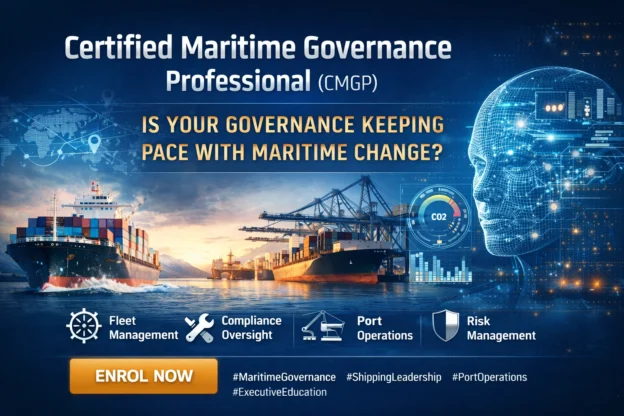
Certified Maritime Governance Professional (CMGP) is a specialised executive certification developed to equip maritime leaders with the governance expertise required to supervise modern shipping and port operations. The global maritime industry is undergoing a profound transformation driven by digitalisation, environmental regulation, technological automation and increasing geopolitical complexity in international trade routes. In this environment, effective governance has become a strategic capability rather than a purely administrative function.
The Certified Maritime Governance Professional certification has been designed to address this emerging need. Shipping companies, port authorities, maritime logistics operators and regulatory agencies increasingly require professionals who understand how governance frameworks guide decision-making, manage risk and ensure compliance with international maritime standards. As maritime operations grow more technologically sophisticated, governance professionals must ensure that organisational oversight structures evolve alongside operational innovation.
Governance within maritime organisations involves the structured systems, policies and accountability mechanisms that ensure operational activities align with regulatory expectations and organisational strategy. Through the Certified Maritime Governance Professional programme, participants gain a comprehensive understanding of how governance functions operate across shipping operations, port management, maritime supply chains and regulatory oversight institutions.
Why Maritime Governance Is Becoming a Strategic Priority
The maritime sector remains one of the most heavily regulated industries in the world. International conventions, regional regulatory frameworks and national maritime authorities establish extensive requirements governing vessel operations, environmental protection, labour standards and safety management. Maritime organisations must therefore maintain robust governance systems capable of monitoring compliance and responding effectively to regulatory developments.
The Certified Maritime Governance Professional certification enables maritime leaders to understand how governance structures operate within this regulatory environment. Participants explore how oversight frameworks are designed to ensure that maritime organisations maintain transparency, accountability and operational discipline. Effective governance ensures that shipping companies and port authorities can meet regulatory obligations while maintaining efficiency and commercial competitiveness.
Beyond regulatory compliance, maritime governance also plays a critical role in managing organisational risk. Shipping operations involve exposure to operational hazards, environmental liabilities, financial volatility and geopolitical disruptions affecting global supply chains. Governance professionals must therefore establish oversight mechanisms that identify risk, monitor operational performance and ensure that leadership decisions are aligned with organisational risk tolerance. The Certified Maritime Governance Professional programme provides structured frameworks that enable participants to evaluate governance maturity within their organisations and implement improvements that strengthen resilience.
Governance Challenges in the Modern Maritime Industry
The rapid integration of digital technologies into maritime operations has introduced new governance challenges. Modern shipping fleets rely on sophisticated digital systems for navigation, predictive maintenance, emissions monitoring and operational analytics. Port authorities increasingly deploy automated cargo handling systems, digital traffic management platforms and integrated logistics data networks.
These technological innovations create operational efficiency but also require stronger governance oversight. Decision-making processes must remain transparent and accountable even when supported by automated systems or advanced analytics platforms. The Certified Maritime Governance Professional course examines how governance structures must adapt to supervise digital maritime environments while maintaining organisational accountability.
Cybersecurity has also become a major governance concern for maritime organisations. Shipping companies and port operators increasingly rely on interconnected digital infrastructure to coordinate logistics operations and communicate with global supply chain partners. Governance professionals must therefore ensure that cybersecurity policies, risk assessments and incident response frameworks are integrated into organisational governance systems.
Through the Certified Maritime Governance Professional certification, participants develop the expertise required to address these emerging governance challenges while maintaining alignment with maritime safety and regulatory standards.
Risk Management and Accountability in Maritime Governance
One of the most important responsibilities of governance professionals in maritime organisations is the establishment of structured risk management systems. Maritime operations involve complex interactions between vessels, ports, logistics networks, regulatory authorities and international trade systems. Governance frameworks must therefore ensure that risks are identified, monitored and mitigated effectively.
The Certified Maritime Governance Professional programme introduces participants to governance methodologies that integrate risk management into organisational decision-making. These methodologies enable maritime leaders to evaluate operational risk exposure, design oversight mechanisms and ensure that risk mitigation strategies are embedded within organisational policies.
Accountability is another fundamental principle of maritime governance. Stakeholders including regulators, investors, insurers and supply chain partners increasingly demand evidence that maritime organisations operate responsibly and in accordance with established standards. Governance professionals must therefore ensure that reporting systems, audit processes and compliance documentation provide reliable evidence of operational integrity. Participants in the Certified Maritime Governance Professional certification programme learn how governance frameworks support organisational accountability and how leadership oversight ensures that maritime institutions maintain stakeholder trust.
Environmental Governance and Sustainability in Shipping
Environmental responsibility has become a central concern for the maritime industry. Governments, international organisations and environmental regulators are placing increasing emphasis on reducing maritime emissions, improving energy efficiency and protecting marine ecosystems. Maritime organisations must therefore incorporate sustainability principles into their governance frameworks.
The Certified Maritime Governance Professional course addresses the governance responsibilities associated with environmental compliance and sustainability reporting. Participants examine how governance structures monitor emissions performance, supervise environmental management systems and ensure that sustainability commitments are integrated into organisational strategy.
Effective environmental governance requires coordination between operational teams, regulatory compliance units and executive leadership. The Certified Maritime Governance Professional programme provides practical frameworks that help maritime organisations align environmental responsibility with operational performance.
Strategic Leadership and Governance Capability
Governance professionals must also possess strong leadership capabilities. Governance decisions influence organisational culture, strategic direction and stakeholder relationships. Leaders responsible for governance must communicate effectively with executive teams, board members, regulators and operational managers.
The Certified Maritime Governance Professional certification emphasises the development of strategic leadership skills alongside governance expertise. Participants learn how governance frameworks influence organisational strategy and how governance leaders guide decision-making in complex operational environments. As maritime organisations navigate technological disruption, regulatory complexity and environmental responsibilities, governance leadership will play an increasingly important role in ensuring sustainable industry growth.
The Value of Becoming a Certified Maritime Governance Professional
The Certified Maritime Governance Professional (CMGP) certification represents a significant professional milestone for maritime leaders seeking to strengthen their expertise in governance, compliance and strategic oversight. By completing the programme, participants gain the knowledge required to design governance frameworks, evaluate organisational governance maturity and implement best practices across maritime institutions.
Professionals who achieve the Certified Maritime Governance Professional credential demonstrate their ability to supervise modern maritime operations responsibly and effectively. The certification signals expertise in maritime governance, regulatory compliance, risk management and strategic leadership. In an era where maritime organisations face unprecedented complexity, governance capability will determine long-term resilience and success. The Certified Maritime Governance Professional programme equips leaders with the frameworks and insights required to guide maritime organisations through the evolving global maritime landscape.
Visit our other human resource certifications
Visit our other artificial intelligence certifications
Visit our other digital technology certifications
Visit our other higher education certifications
Course Content
MODULE 1: Foundations of Maritime Governance
Course Includes
- 116 Lessons
- 1 Quiz
- Course Certificate