
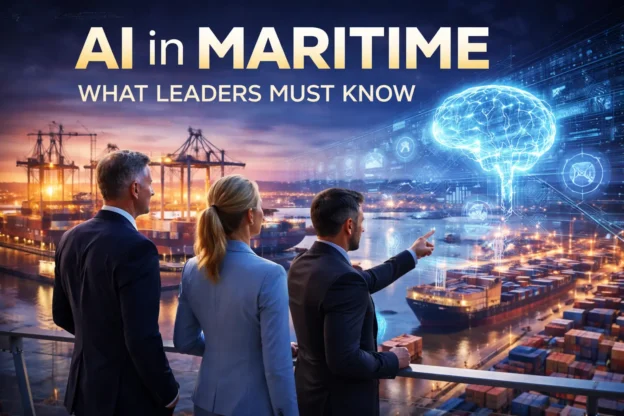
AI in Maritime Is Now a Leadership Responsibility
AI in Maritime is no longer an emerging concept confined to innovation labs or pilot projects. It is actively influencing voyage optimisation, fuel efficiency modelling, predictive maintenance systems, port congestion forecasting, safety monitoring, automated reporting and performance analytics across global shipping operations. For maritime executives, fleet managers, port directors and compliance leaders, artificial intelligence has moved from optional technology to strategic infrastructure.
The reality is simple: AI in Maritime is already embedded in operational decision-making. Whether deployed through vendor platforms, internal analytics tools or integrated operational dashboards, AI systems are shaping cost structures, environmental performance, safety thresholds and commercial outcomes. Yet many leaders remain uncertain about what they are accountable for when those systems influence decisions.
This course addresses that uncertainty directly. It is designed for decision-makers who do not need to build AI systems, but who must govern, oversee and remain accountable for them.
How AI in Maritime Is Changing Shipping and Port Operations
AI in Maritime differs from traditional maritime software. Conventional systems follow predefined rules and predictable workflows. Artificial intelligence, by contrast, learns from data, adapts to patterns and produces probabilistic outputs. That difference changes leadership responsibility.
Across the maritime sector, AI is currently being used to:
- Optimise vessel routing based on weather and fuel models
- Predict equipment failure and reduce unplanned downtime
- Analyse cargo flows and forecast congestion in terminals
- Monitor safety parameters and generate automated alerts
- Support emissions tracking and regulatory reporting
- Enhance claims analysis and commercial risk detection
These applications offer efficiency gains and cost reductions, but they also introduce new exposure. When AI in Maritime systems recommend operational decisions, leaders must understand how those recommendations are generated, what assumptions underpin them and how oversight is maintained.
Without structured governance, AI adoption can create hidden risks, including automation bias, data drift, misaligned performance incentives and unclear escalation authority.
Why Governance and Accountability Matter in AI in Maritime
Maritime operations are safety-critical, globally regulated and legally exposed. Decisions affect crew safety, asset integrity, environmental compliance and contractual obligations. Introducing AI into such environments does not reduce accountability; it redistributes it.
Leaders remain responsible for outcomes, even when decisions are influenced by algorithms. Questions that increasingly arise in boardrooms, audits and insurance reviews include:
- Who owns the output of an AI-driven decision system?
- What human oversight exists over AI recommendations?
- How are overrides documented and justified?
- How is model performance monitored over time?
- What happens when AI contributes to an operational incident?
AI in Maritime therefore becomes a governance issue, not merely a technology issue. Effective leadership requires clarity around decision boundaries, escalation protocols, documentation standards and audit readiness.
This course provides that clarity.
Risk, Compliance and Regulatory Considerations
AI in Maritime operates within a complex international regulatory framework. Shipping companies and port authorities already manage safety management systems, environmental reporting requirements and compliance audits. Artificial intelligence intersects with each of these domains.
When AI systems influence fuel optimisation or emissions reporting, regulatory exposure increases. When AI-driven alerts shape safety responses, incident accountability becomes more complex. When predictive analytics support commercial claims decisions, legal defensibility must be considered.
Leaders must understand how AI systems align with existing management systems and compliance obligations. They must ensure that AI does not undermine established controls, reporting mechanisms or audit processes. Governance frameworks such as ISO-aligned management systems increasingly require structured oversight of AI applications, and maritime organisations are expected to demonstrate due diligence in their adoption.
This course equips leaders to engage confidently with regulators, auditors and insurers regarding AI in Maritime operations.
The Organisational Impact of AI in Maritime
Beyond governance and compliance, AI in Maritime changes how organisations function internally. It influences job roles, authority structures and performance metrics. If AI recommendations are accepted without challenge, professional judgement may erode. If AI outputs are distrusted, adoption may fail.
Effective leadership ensures balance. AI must support human expertise rather than replace it. Human-in-command principles, escalation pathways and competence frameworks must be clearly defined. Leaders must communicate transparently about what AI can and cannot do.
Cultural readiness is therefore as important as technical capability. This course examines how maritime organisations can prepare teams for AI-enabled environments without compromising safety culture or accountability.
What Leaders Will Gain from This Course
AI in Maritime is not about learning to code or design algorithms. It is about developing the confidence and competence to lead in an AI-enabled operational landscape.
Participants will gain:
- A structured understanding of how AI systems function in maritime contexts
- Clarity on governance, oversight and accountability frameworks
- Insight into operational, legal and insurance exposure linked to AI use
- Tools to assess organisational readiness and vendor risk
- The ability to ask informed, strategic questions before approving AI initiatives
By the end of the course, leaders will be equipped to move from reactive adoption to structured governance. They will understand how to ensure that AI enhances safety, efficiency and compliance without introducing unmanaged risk.
Who This Course Is Designed For
This programme is designed for professionals who hold decision-making authority or oversight responsibility within maritime and shipping organisations, including:
- Shipping executives and board members
- Fleet managers and technical superintendents
- Port authority and terminal directors
- Compliance, QHSE and regulatory professionals
- Risk managers and insurance liaison officers
- Maritime consultants and advisory professionals
It is particularly relevant for those involved in digital transformation, performance optimisation and governance strategy.
What This Course Is and What It Is Not
This course is a leadership-focused exploration of AI in Maritime governance, risk and accountability. It does not teach programming, data science modelling or technical system configuration.
Instead, it provides a management-level understanding that enables leaders to oversee AI responsibly within real operational contexts.
Participants will leave with enhanced strategic awareness, improved risk literacy and a clear framework for supervising AI-enabled systems within maritime environments.
Prepare to Lead in an AI-Enabled Maritime Environment
AI in Maritime is not a passing trend. It represents a structural shift in how shipping companies, ports and maritime organisations operate and compete. Leaders who understand its implications will be better positioned to protect their organisations, optimise performance and maintain trust.
Enrol in AI in Maritime: What Leaders Must Know to build the governance confidence required for accountable leadership in a rapidly evolving operational landscape.
Course Content
MODULE 1: Understanding AI in Maritime Operations
Course Includes
- 19 Lessons
- 1 Quiz
- Course Certificate