

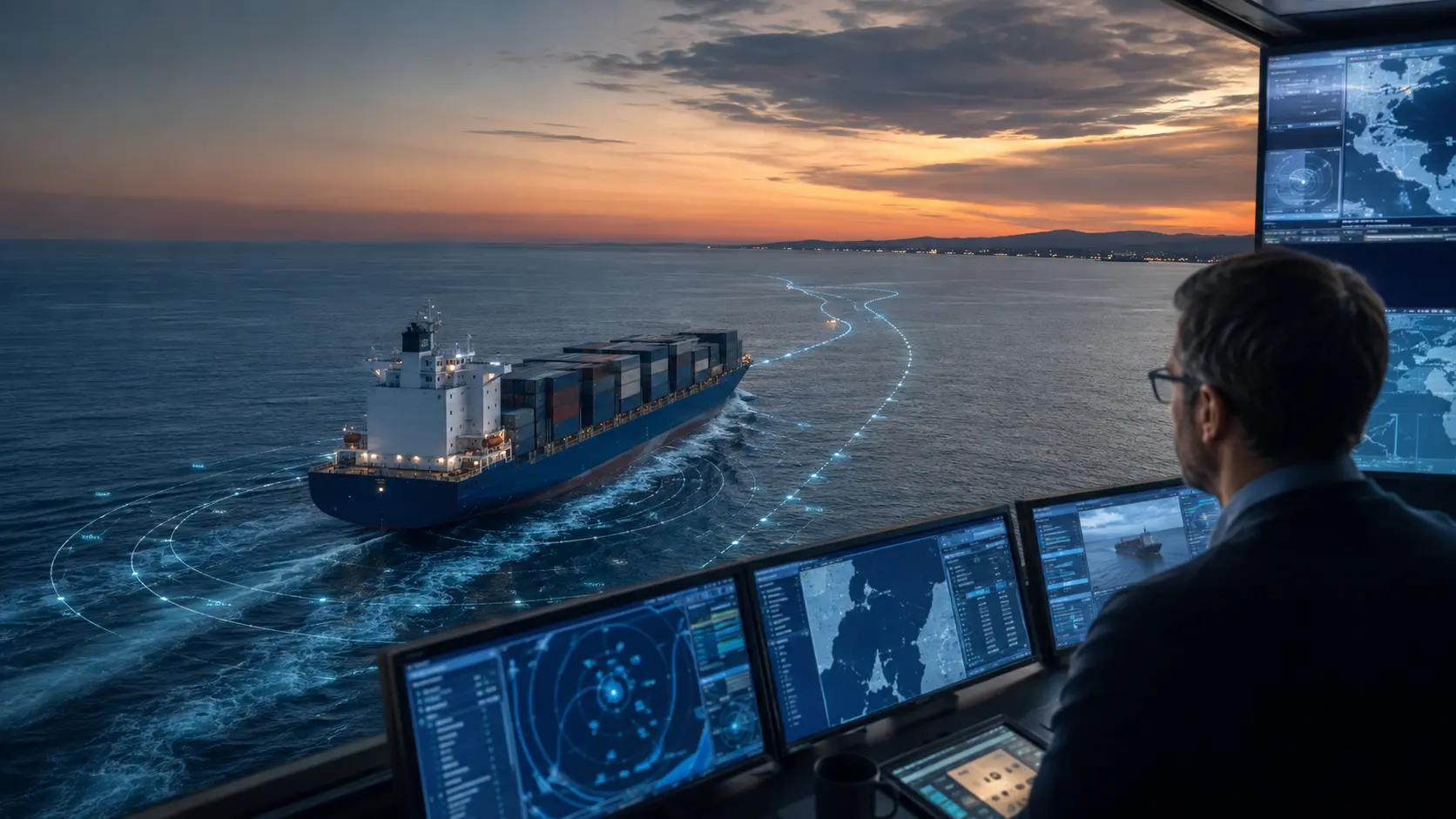
The first International Code of Safety for Maritime Autonomous Surface Ships is no longer a future proposal. Adopted by the International Maritime Organization (IMO) in May, the non-mandatory Code took effect on 1 July 2026. For shipowners, operators, ports, technology suppliers and maritime boards, the immediate question is not whether every vessel is about to become crewless. It is whether the organisation can demonstrate that autonomous and remotely operated functions are governed as rigorously as conventional ship operations.
That is a more demanding test than buying new technology. It requires leaders to define where autonomy begins and ends, assign responsibility across vessel and shore, prove safe behaviour within stated operating limits, prepare for degraded states, manage connectivity and cyber risk, and retain meaningful human oversight.
The IMO MASS Code 2026 creates a global reference point for doing this. It is goal-based and technology-neutral, and it seeks a level of safety, security and environmental protection equivalent to that expected of a conventional ship. It also makes an important distinction that is often lost in headlines: advanced automation alone does not automatically make a vessel a Maritime Autonomous Surface Ship (MASS).
This guide translates the MASS Code into eight practical leadership actions. It is an operational interpretation for management and learning purposes, not legal or flag-State advice.
What the IMO MASS Code 2026 actually covers
A MASS is a ship that, to varying degrees, can operate independently of human interaction. Under the IMO framework, autonomous or remote technologies must replace or support functions normally performed by crew, and the vessel must complete the relevant approval process and hold a valid MASS Safety Certificate. Ordinary automation—however sophisticated—does not by itself create MASS status.
The non-mandatory Code applies to cargo ships covered by SOLAS Chapter I, including associated Remote Operations Centres (ROCs), where an Administration considers existing requirements impracticable or insufficient for the autonomous or remotely operated functions. IMO also recommends applying the framework, as far as practicable, to relevant ships below 500 gross tonnage.
Its reach is deliberately broad. The MASS Code addresses design, approval and operation, including navigation, connectivity, remote operations, fire safety, search and rescue, cybersecurity, risk assessment, safety management and the human element. Existing obligations under SOLAS and other applicable instruments still matter; the MASS Code supplements rather than displaces them.
The practical implication is that the IMO MASS Code 2026 should not be treated as a narrow technical standard owned by naval architects or IT teams. It changes the governance interface between the board, the Company, the master, remote operators, onboard crew, equipment suppliers, classification bodies and Administrations.
First, determine whether the vessel or function is genuinely in scope
Begin with functions, not labels. Marketing terms such as “smart ship”, “AI-enabled vessel” or “autonomous-ready platform” do not settle the regulatory position. Leaders should map every function that can act without immediate human intervention or can be controlled from shore.
For each function, record:
- What the system senses, decides and controls.
- Whether it operates autonomously, remotely or conventionally.
- Which modes can change during a voyage and who authorises the change.
- Whether people remain on board and what duties they retain.
- Which vessel, shore and third-party systems the function depends upon.
- Which Administration, class and contractual approvals may be required.
This functional map prevents two opposite errors: assuming that any use of AI brings the whole ship within the MASS framework, or assuming that an autonomous function is outside scope because the vessel still carries crew. The MASS Code can be implemented for individual autonomous or remotely operated functions even where people remain on board for other duties.
Second, build a credible Concept of Operations
Under the MASS Code, the Concept of Operations, or ConOps, should explain how the ship is intended to work—not merely describe the technology. A defensible ConOps connects the commercial use case to operational modes, human roles, system boundaries, communications, environmental limits, abnormal situations and recovery arrangements.
A board should be able to read the ConOps and answer five questions:
- What can the vessel or autonomous function do?
- Under which defined conditions may it do so?
- Who monitors, intervenes and remains accountable?
- What happens when information, connectivity or equipment degrades?
- How will safe control be restored or transferred?
If those answers exist only in vendor presentations, the organisation is not ready. The ConOps must become the common reference used by operations, safety, engineering, cyber, training, procurement and assurance teams.
Third, define the operational envelope and fallback states
The IMO MASS Code 2026 expects leaders to specify the conditions within which the system can operate safely. These may include sea state, wind, visibility, water depth, traffic density, geographical limits, communications availability and day or night operations. The relevant limits will differ by vessel, function and mode.
The difficult governance question is what happens at the boundary. An autonomous navigation system may perform well in normal conditions yet become unreliable when sensors disagree, communications degrade or traffic behaviour becomes unusual. Leaders therefore need predefined triggers for changing mode, reducing activity, transferring control, entering a safe state or requesting human intervention.
A structured hazard method can help turn broad concerns into evidence. The European Maritime Safety Agency’s Risk-Based Assessment Tool provides a practical five-step approach for defining automation use, analysing hazards, evaluating mitigations and implementing controls for autonomous vessel operations.
The quality test is not whether a fallback procedure exists on paper. It is whether the transition has been tested with realistic delays, incomplete information, competing alarms and limited operator attention.
Fourth, make human oversight operational
The IMO MASS Code 2026 retains the human element at its centre. The master remains responsible for the ship at all times, even when not physically on board. That makes vague statements such as “a human can intervene” insufficient.
Effective oversight requires a named person who has:
- Reliable situational awareness.
- The competence to interpret system behaviour and limitations.
- Clear authority to intervene, override or change operating mode.
- Enough time and attention to act before the situation becomes unsafe.
- A tested means of communicating with other responsible personnel.
- Protection from commercial pressure when a safety intervention is necessary.
Boards should ask a harder question than “Is there a person in the loop?” They should ask whether that person can understand what is happening, decide in time and exercise effective control. This moves human oversight from a diagram to a verifiable operating capability.
Fifth, govern the Remote Operations Centre as part of the ship system
A Remote Operations Centre is not simply an office containing screens. It can become a safety-critical extension of the vessel. The IMO MASS Code 2026 expects ROCs to be assessed, certified and operated through robust safety-management arrangements. Tasks and relationships between the Company, the vessel and each ROC should be clearly documented.
Leadership review should cover:
- Operator competence, certification, fatigue and workload.
- The number and complexity of vessels supervised simultaneously.
- Handover between operators, shifts, centres and operating modes.
- Communications resilience, latency and loss-of-link procedures.
- Physical security, access control and business continuity.
- Alarm prioritisation and human–machine interface design.
- Authority boundaries between the master, remote operators and onboard crew.
- Recording, investigation and learning from remote-operation events.
This is where MASS Code governance and operations meet. A technically capable ROC can still be unsafe if accountability is fragmented, staffing assumptions are unrealistic or handovers are weak.
Sixth, integrate cyber risk into safety management
Autonomy increases dependence on software, sensors, data and connectivity. A cyber event can therefore become a navigational, safety, security or environmental event. IMO’s maritime cyber-risk guidance defines cyber-risk management as identifying, analysing, assessing and communicating cyber-related risk, then accepting, avoiding, transferring or mitigating it to an acceptable level. It also links cyber risk directly to existing safety-management systems.
For the IMO MASS Code 2026, leaders should avoid separating “cybersecurity” from “marine safety”. A compromised sensor feed, unauthorised command, corrupted chart, lost connection or malicious update can alter physical vessel behaviour.
At minimum, the organisation should verify identity and access controls, network segmentation, secure software updates, supplier access, logging, anomaly detection, incident response and recovery from loss of trusted data. Testing should include the safe continuation or fallback of operations when digital controls are unavailable—not only the prevention of intrusion.
Seventh, convert supplier claims into acceptance evidence
Many autonomous functions are assembled from components supplied by multiple vendors. The operator still needs coherent MASS Code evidence for the behaviour of the combined system. Procurement must therefore ask what each component is designed to do, its operating limits, known failure modes, dependencies, update arrangements and assurance evidence.
A useful acceptance gate is: claim, evidence, test, owner and response.
- Claim: What precisely is the supplier promising?
- Evidence: Which design record, test report or assurance result supports it?
- Test: Can the behaviour be reproduced in the intended operating context?
- Owner: Who monitors the control after commissioning?
- Response: What happens when the component changes or fails?
This approach protects leaders from accepting impressive demonstrations as proof of operational fitness. It also provides a clearer basis for warranty, notification, audit-access, incident-support and change-control clauses.
Eighth, establish an evidence-building programme now
The IMO MASS Code 2026 is non-mandatory, but it is deliberately designed to support a transition towards binding rules. IMO’s current roadmap includes development of an Experience-Building Phase framework in December 2026, work on a mandatory Code in 2028, expected adoption by July 2030 and entry into force in January 2032.
Waiting for mandatory rules would waste the most valuable period for organisational learning. Operators considering autonomous or remote functions should begin building structured evidence from trials, simulations, near misses, mode changes, human interventions, communications failures, cyber exercises and safety reviews.
The evidence programme should answer:
- Which assumptions were tested?
- Which operating conditions were represented?
- What failed, degraded or behaved unexpectedly?
- How did people detect and manage the change?
- Which controls were revised?
- What evidence will be retained for approval, insurance, audit and future certification?
An evidence-building approach turns compliance preparation into operational improvement. It gives leaders a factual basis for investment, limits, training and scale-up decisions.
A 90-day readiness plan for maritime organisations
Organisations do not need to redesign an entire fleet to respond intelligently. A focused 90-day MASS Code readiness programme can establish whether current or planned autonomy is being governed properly.
| Period | Leadership deliverable |
| Days 1–30: Scope and ownership | Inventory autonomous and remotely operated functions; nominate an executive owner; map vessel, ROC, supplier and Administration responsibilities; identify the applicable approvals and current evidence. |
| Days 31–60: Risk and control | Develop or revise the ConOps; define operational limits and fallback states; assess human oversight, ROC arrangements and cyber dependencies; identify the highest-priority assurance gaps. |
| Days 61–90: Test and learn | Run scenario-based exercises; test mode transfers, loss of connectivity and degraded information; record findings; update procedures, contracts and training; agree the continuing evidence-building schedule. |
What this means for AI in maritime leadership
Autonomous shipping and maritime AI overlap, but they are not interchangeable. The MASS Code is technology-neutral: a function can meet its definition through technologies that are not described as AI, while many uses of AI in shipping—such as forecasting, maintenance analysis or administrative support—will not make a ship a MASS.
The leadership disciplines are nevertheless closely connected. Both require clear system boundaries, accountable decisions, competent human oversight, realistic testing, supplier assurance, cyber resilience and evidence across the lifecycle.
Professionals responsible for these decisions can strengthen their management-level understanding through AI in Maritime: What Leaders Must Know. The paid course focuses on maritime AI strategy, governance, risk, accountability and vendor evaluation rather than programming. Those seeking broader institutional oversight can also explore the Certified Maritime Governance Professional programme.
For supporting practical context, see The Case HQ’s guide to maritime risk management and the complete collection of maritime and shipping courses.
The leadership test is evidence, not enthusiasm
The IMO MASS Code 2026 does not announce the sudden arrival of crewless global shipping. It establishes a disciplined route for integrating autonomous and remotely operated functions without weakening the safety, security, environmental protection and accountability expected of conventional operations.
For maritime leaders, the central test is simple: can the organisation explain what the system is authorised to do, the conditions within which it can act, who remains responsible, how people intervene, what happens when the system degrades and which evidence proves that the controls work?
If those answers are clear, tested and owned, autonomy can be approached as a governed operational capability. If they are not, the technology is ahead of the organisation.
Frequently asked questions
Is the IMO MASS Code 2026 mandatory?
No. The MASS Code currently provides a non-mandatory, goal-based framework. It took effect on 1 July 2026 and is intended to support experience-building and the future development of a mandatory instrument.
Does every AI-enabled ship count as a MASS?
No. Enhanced automation or the use of AI does not automatically make a ship a MASS. The relevant autonomous or remotely operated functions, operating modes, approval process and certification determine the position.
Does the Code remove the need for a ship’s master?
No. The IMO framework retains a human master with overall responsibility for the ship, even where the master is not physically on board.
What is a Remote Operations Centre?
A ROC is a shore-based centre from which qualified personnel can monitor or control some or all MASS functions. Under the MASS Code, it should be incorporated into suitable assessment, certification and safety-management arrangements.
Why should organisations act while the MASS Code is voluntary?
Early action allows operators to test assumptions, strengthen governance, improve safety evidence, prepare people and suppliers, and contribute useful experience before the framework becomes mandatory.
Responses