

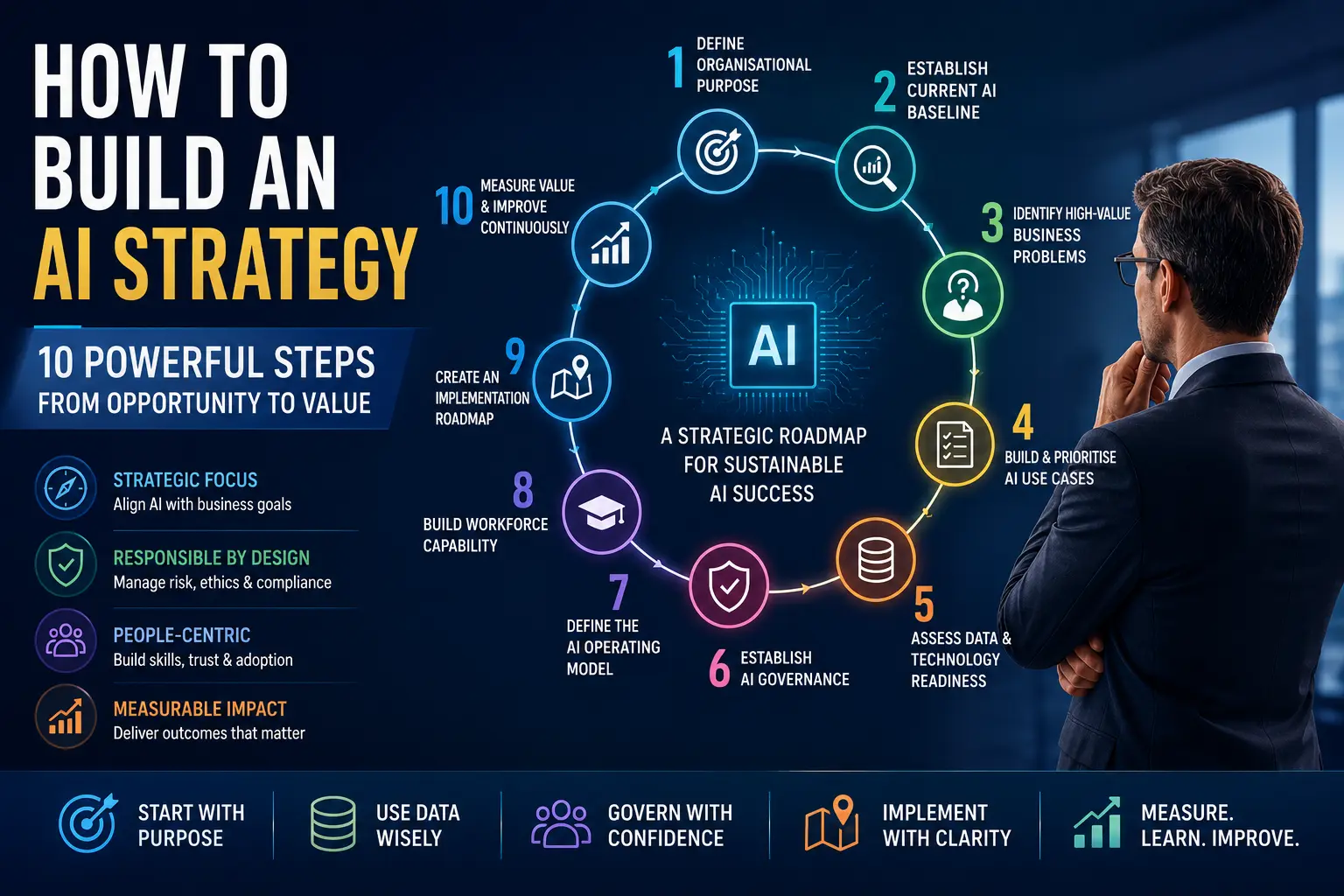
How to build an AI strategy is now a practical leadership question rather than a technology exercise. A credible strategy should explain where artificial intelligence can create value, which capabilities the organisation needs, how risks will be governed, and how promising ideas will move from experimentation to measurable results.
An effective AI strategy does not begin with buying software or asking every department to find an AI use case. It begins with organisational priorities, clearly defined problems and disciplined decisions about where AI is—and is not—the appropriate response.
This guide presents a ten-step method that managers, consultants and transformation leaders can use to develop an actionable AI strategy without turning it into an abstract technology document.
Table of contents
- What is an AI strategy?
- Why organisations need an AI strategy
- How to build an AI strategy in 10 steps
- Step 1: Define the organisational purpose
- Step 2: Establish the current AI baseline
- Step 3: Identify high-value business problems
- Step 4: Build and prioritise AI use cases
- Step 5: Assess data and technology readiness
- Step 6: Establish AI governance
- Step 7: Define the AI operating model
- Step 8: Build workforce capability
- Step 9: Create an implementation roadmap
- Step 10: Measure value and improve continuously
- What should an AI strategy document contain?
- A practical AI strategy example
- Common AI strategy mistakes
- Who should lead AI strategy development?
- How long should AI strategy development take?
- Final perspective
- Frequently asked questions
What is an AI strategy?
An AI strategy is a structured plan explaining how an organisation will use artificial intelligence to support its strategic objectives.
It should connect six elements:
- Organisational priorities
- Valuable business problems
- Suitable AI use cases
- Data and technology capabilities
- Governance and accountability
- Implementation and value measurement
A strong AI strategy is therefore more than a list of tools, projects or ambitions.
Statements such as “we will become AI-driven” or “every department should adopt generative AI” may express enthusiasm, but they do not explain what the organisation will do, why it will do it or how leaders will determine whether the effort has succeeded.
A practical strategy should clarify:
- Which outcomes the organisation wants to improve
- Where AI may contribute to those outcomes
- Which opportunities should be prioritised
- Which proposals should not proceed
- What capabilities must be developed
- Who will make decisions
- How risks will be managed
- How implementation will be phased
- How value will be measured
Professionals who need to develop these capabilities can explore the Certified AI Business Strategist course, which focuses on connecting AI opportunities with business strategy, organisational readiness and implementation.
Why organisations need an AI strategy
Many organisations already use AI without describing it as a formal programme.
Employees may use generative AI tools to draft content, summarise documents or analyse information. Departments may purchase specialised applications for recruitment, marketing, forecasting, customer service or cybersecurity.
This activity can create local benefits, but it can also produce fragmentation.
Without a clear strategy, an organisation may experience:
- Duplicate subscriptions
- Uncontrolled data sharing
- Inconsistent governance
- Unclear accountability
- Low-value experiments
- Conflicting technology choices
- Employee uncertainty
- Unmeasured benefits
- Vendor dependency
- Projects that cannot scale
An AI strategy provides a common direction without requiring every initiative to be controlled centrally.
It allows departments to innovate within agreed boundaries while ensuring that investment, risk and organisational learning are coordinated.
Strategy helps organisations distinguish opportunity from fashion
AI attracts considerable attention, but not every organisational problem requires it.
Some problems may be solved more effectively through:
- Process redesign
- Better data management
- Conventional automation
- Staff development
- Clearer policies
- Improved system integration
- Stronger management
An AI strategy should help leaders compare these alternatives rather than assuming that AI is automatically the best solution.
Strategy helps turn experiments into organisational capability
A pilot can demonstrate whether a particular application works. It does not automatically create an organisation capable of using AI repeatedly and responsibly.
Long-term capability requires:
- Governance
- Data foundations
- Technical integration
- Skilled employees
- Leadership
- Procurement standards
- Monitoring
- Knowledge sharing
The strategy should address both immediate projects and the organisational system required to support them.
How to build an AI strategy in 10 steps
The ten steps are:
- Define the organisational purpose.
- Establish the current AI baseline.
- Identify high-value business problems.
- Build and prioritise AI use cases.
- Assess data and technology readiness.
- Establish AI governance.
- Define the AI operating model.
- Build workforce capability.
- Create an implementation roadmap.
- Measure value and improve continuously.
These steps are presented in sequence, but the process is not entirely linear.
For example, a readiness assessment may reveal that a promising use case requires stronger data governance. A governance discussion may show that an apparently simple project carries greater risk than expected. The organisation may then revise its priorities.
Iteration is therefore a sign of disciplined strategy development, not failure.
Step 1: Define the organisational purpose
The first step in learning how to build an AI strategy is to establish why the organisation is considering AI.
The purpose should be connected to existing strategic priorities rather than written as a separate technology ambition.
Examples may include:
- Improving customer experience
- Reducing service delays
- Increasing operational efficiency
- Strengthening forecasting
- Improving product quality
- Supporting employee decision-making
- Expanding access to services
- Accelerating research and innovation
- Managing risk more effectively
- Creating new products or business models
Begin with strategic questions
Leadership teams should ask:
- What are our most important organisational objectives?
- Which performance problems prevent progress?
- Where do customers or service users experience difficulty?
- Which decisions depend on slow or incomplete analysis?
- Where is employee effort consumed by repetitive work?
- Which risks are becoming harder to manage?
- What capabilities will competitors or stakeholders expect from us?
- Where could better prediction, classification, generation or recommendation create value?
These questions keep AI connected to the organisation’s purpose.
Create a concise strategic intent
The organisation should develop a short statement explaining what it wants AI to achieve.
For example:
Our organisation will use AI selectively to improve service responsiveness, strengthen operational decision-making and reduce repetitive administrative work while maintaining human accountability, data protection and service quality.
This statement is more useful than:
We aim to become an AI-first organisation.
The first statement identifies intended outcomes and operating boundaries. The second may encourage technology adoption without sufficient judgement.
Avoid setting adoption as the objective
The number of AI tools used is not a meaningful strategic outcome.
Similarly, the following measures are insufficient on their own:
- Number of pilots launched
- Number of employees trained
- Number of AI licences purchased
- Number of departments experimenting
- Number of prompts submitted
These measures may show activity, but they do not demonstrate organisational improvement.
The strategic purpose should relate to measurable outcomes such as time, cost, quality, revenue, risk, access or stakeholder experience.
Step 2: Establish the current AI baseline
Before defining future priorities, the organisation should understand its present position.
AI activity often develops informally. Senior leaders may not know which tools employees use, which departments have purchased systems or what data are being shared with external platforms.
A baseline assessment creates visibility.
Map existing AI activity
The organisation should identify:
- AI-enabled systems already in use
- Approved and unapproved generative AI tools
- Active pilots
- Departmental subscriptions
- Vendor-provided AI features
- Automated decision-support systems
- Research or innovation projects
- Employee-created workflows
- Existing policies and guidance
This is not intended only as a compliance exercise. The assessment may reveal valuable practices that can be supported and scaled.
Assess current maturity
A practical maturity assessment may consider five areas.
Strategy
- Is there a defined organisational purpose?
- Are AI priorities connected to business objectives?
- Are investment decisions coordinated?
Data and technology
- Are data reliable and accessible?
- Can systems be integrated?
- Is technical ownership clear?
- Can AI performance be monitored?
Governance
- Are policies and responsibilities defined?
- Are risk assessments conducted?
- Is human oversight established?
- Are incidents reported?
People
- Do leaders understand AI sufficiently?
- Are employees receiving role-appropriate training?
- Are specialists available?
- Is adoption supported?
Delivery
- Are pilots evaluated consistently?
- Are benefits measured?
- Can successful projects be scaled?
- Are lessons shared?
Identify strengths as well as weaknesses
A baseline should not become a list of deficiencies.
The organisation may already possess useful foundations, such as:
- Strong data governance
- Experienced transformation teams
- Existing automation capability
- Active innovation communities
- Reliable cloud infrastructure
- Supportive senior leadership
- Effective risk-management processes
The strategy should build on these capabilities rather than creating a completely separate AI structure.
Step 3: Identify high-value business problems
AI strategy should be problem-led rather than tool-led.
The organisation should identify specific areas where current performance is inadequate and where AI may contribute to improvement.
Use evidence to define the problem
A useful problem statement includes:
- The existing process or decision
- The affected stakeholders
- The performance gap
- The consequences
- Available evidence
- The desired improvement
For example:
Procurement specialists spend approximately 30% of their review time comparing repetitive supplier documentation, delaying evaluation and limiting the time available for strategic vendor analysis.
This is more useful than:
Procurement should use AI.
The first statement supports a structured assessment of possible responses. The second jumps directly to a solution.
Sources of business problems
Potential opportunities may be identified through:
- Customer complaints
- Operational performance reports
- Employee interviews
- Process mapping
- Audit findings
- Risk registers
- Strategic plans
- Benchmarking
- Market analysis
- Service-quality data
- Management workshops
Distinguish symptoms from causes
A long processing time may be a symptom of:
- Incomplete information
- Repeated approvals
- Poor system integration
- Unclear responsibilities
- Manual data entry
- Complex regulation
- Inadequate training
AI may address one element while leaving the underlying cause unchanged.
The strategist should therefore ask why the problem exists before proposing a use case.
Create an opportunity register
Each potential problem can be recorded using a simple structure:
| Field | Description |
|---|---|
| Business area | Department or process affected |
| Problem | Specific performance gap |
| Evidence | Data demonstrating the issue |
| Stakeholders | People affected by the problem |
| Potential AI contribution | How AI might help |
| Alternatives | Non-AI options |
| Expected value | Possible improvement |
| Principal risks | Potential adverse effects |
| Owner | Responsible business leader |
This register becomes the foundation for use-case development.
Step 4: Build and prioritise AI use cases
A business problem becomes an AI use case when the organisation defines how AI could contribute to a specific outcome.
A credible use case should explain:
- The problem
- The intended users
- The AI-supported activity
- The required data
- The expected output
- The human decision or action
- The anticipated benefit
- The potential risks
- The measure of success
Example use case
Consider an organisation experiencing a high volume of customer enquiries.
A poorly defined use case would be:
Implement an AI chatbot.
A stronger use case would be:
Use an AI-supported service assistant to help customer-service employees retrieve approved policy information more quickly, with employees reviewing responses before they are sent.
The stronger version clarifies:
- The user
- The purpose
- The role of AI
- The human oversight
- The expected improvement
Prioritise through structured criteria
Use cases can be evaluated across several dimensions.
| Criterion | Question |
|---|---|
| Strategic alignment | Does the use case support a major organisational objective? |
| Business value | Could the improvement be meaningful? |
| Data readiness | Are suitable data available? |
| Technical feasibility | Can the solution be developed or purchased realistically? |
| Adoption readiness | Will users incorporate it into their work? |
| Risk | Could it harm individuals or the organisation? |
| Implementation effort | What resources and coordination are required? |
| Time to evidence | How quickly can the organisation test the assumptions? |
| Scalability | Could the capability be extended after a successful pilot? |
A numerical scoring model can support comparison, but it should not replace leadership judgement.
Select a balanced portfolio
The first AI portfolio should not contain only the most ambitious ideas.
A balanced set may include:
- A low-risk productivity application
- A customer or service improvement
- An operational optimisation project
- A strategic experiment
- A capability-building initiative
This allows the organisation to create value while developing experience.
Define which uses are unacceptable
Prioritisation should also establish boundaries.
The organisation may decide not to proceed with use cases that:
- Remove human review from high-impact decisions
- Depend on data of insufficient quality
- Create unacceptable privacy exposure
- Cannot be monitored
- Lack a responsible business owner
- Produce limited value relative to risk
- Conflict with organisational values or legal duties
A strategy becomes more credible when it explains what the organisation will not do.
Step 5: Assess data and technology readiness
An AI strategy can fail when attractive use cases are selected without examining the foundations required to deliver them.
Assess data readiness
For each priority use case, examine:
- Data availability
- Data completeness
- Accuracy
- Timeliness
- Consistency
- Ownership
- Access rights
- Privacy requirements
- Historical bias
- Documentation
- Retention arrangements
AI systems depend on the context and quality of the information used to develop, configure or operate them.
A large volume of data is not automatically useful. The data must be relevant, lawful, reliable and sufficiently representative for the intended purpose.
Assess technical readiness
The organisation should evaluate:
- Existing infrastructure
- System integration
- Cybersecurity
- Cloud capability
- Identity and access management
- Application programming interfaces
- Monitoring tools
- Support capacity
- Vendor compatibility
- Technical debt
The strategy does not need to prescribe every technical design. It should identify major dependencies and establish how architecture decisions will be governed.
Consider build, buy and adapt options
The organisation may:
- Build a custom system
- Purchase a specialist product
- Activate an AI feature within an existing platform
- Configure a general-purpose model
- Partner with an external provider
- Combine internal and external capabilities
The decision should consider:
- Strategic importance
- Cost
- Speed
- Internal capability
- Data sensitivity
- Integration
- Vendor dependency
- Customisation
- Intellectual property
- Long-term support
Avoid allowing vendors to define the strategy
Vendors can demonstrate available capabilities, but they should not determine organisational priorities.
The organisation should define:
- The problem
- Required outcomes
- Risk boundaries
- Data requirements
- Evaluation measures
Only then should it compare potential solutions.
Step 6: Establish AI governance
Governance determines how AI-related decisions will be made, documented, reviewed and monitored.
It should be proportionate. A low-risk productivity assistant does not require the same controls as an AI system influencing employment, healthcare, credit or safety decisions.
Define decision rights
The strategy should explain who can:
- Propose an AI use case
- Approve a pilot
- Authorise data access
- Select a vendor
- Accept residual risk
- Approve deployment
- Suspend a system
- Report an incident
- Authorise scaling
- Retire an application
Without clear decision rights, projects may become delayed or proceed without sufficient accountability.
Establish risk classification
Use cases may be classified according to factors such as:
- Impact on individuals
- Sensitivity of data
- Degree of automation
- Consequences of error
- Ability to explain outputs
- Scale of deployment
- Regulatory exposure
- Vulnerability of affected groups
Higher-risk applications should require stronger evidence, oversight and approval.
Incorporate recognised frameworks
The voluntary NIST AI Risk Management Framework is designed to help organisations manage risks to individuals, organisations and society. Its core functions—Govern, Map, Measure and Manage—connect governance with contextual analysis, assessment and continuing risk treatment.
The AI Principles promote innovative and trustworthy AI that respects human rights and democratic values. They address areas including transparency, accountability, robustness, security and safety.
Organisations seeking a management-system approach may also consider ISO/IEC 42001:2023, which specifies requirements for establishing, implementing, maintaining and continually improving an AI management system.
These sources should inform the organisation’s approach rather than being copied mechanically.
Define minimum governance requirements
Every significant use case should address:
- Named ownership
- Purpose and intended use
- Data sources
- Human oversight
- Testing
- Performance measures
- Security
- Privacy
- Bias and fairness
- Transparency
- Vendor responsibilities
- Incident response
- Monitoring
- Review frequency
- Retirement conditions
Governance should support responsible innovation, not merely create documentation after decisions have been made.
Step 7: Define the AI operating model
The operating model explains how people, teams and committees will work together to execute the strategy.
Centralised model
A central AI team may control:
- Standards
- Platforms
- specialist expertise
- Governance
- Investment
- Delivery
This can improve consistency but may become disconnected from operational needs.
Decentralised model
Individual functions may develop and manage their own AI initiatives.
This can increase speed and ownership but may create duplication, inconsistent controls and fragmented technology.
Federated model
Many organisations use a federated approach.
A central function provides:
- Strategy
- Governance
- Shared platforms
- Specialist support
- Standards
- Portfolio coordination
Business functions retain responsibility for:
- Identifying problems
- Owning outcomes
- Leading adoption
- Providing subject expertise
- Monitoring operational performance
This model combines enterprise coordination with functional ownership.
Clarify essential roles
A practical operating model may include:
Executive sponsor
Provides authority, resolves barriers and ensures strategic alignment.
AI strategy leader
Coordinates priorities, business cases and portfolio direction.
Business owner
Owns the organisational problem and expected benefits.
Technical owner
Oversees architecture, integration and technical performance.
Data owner
Ensures appropriate access, quality and governance.
Risk and legal specialists
Assess compliance, contractual and ethical implications.
Change leader
Supports adoption, communication and workforce transition.
Users
Provide operational insight and evaluate whether the system is useful.
The Certified Chief AI Officer course is relevant to senior leaders who need to establish enterprise direction, governance and cross-functional accountability for AI.
Step 8: Build workforce capability
AI strategy succeeds through people, not only technology.
Training should be matched to responsibilities rather than providing the same general awareness course to everyone.
Executive leaders need to understand
- Strategic opportunities
- Investment decisions
- Governance
- Risk appetite
- Accountability
- Value measurement
Managers need to understand
- Use-case identification
- Process redesign
- Implementation
- Employee adoption
- Performance monitoring
- Escalation responsibilities
Employees need to understand
- Approved uses
- Prohibited uses
- Data protection
- Output verification
- Human responsibility
- Reporting concerns
Specialists need deeper capability
Technical, data, legal, procurement, cybersecurity and assurance teams require role-specific expertise.
Develop AI literacy before mandating adoption
Employees are more likely to use AI responsibly when they understand:
- Why the organisation is introducing it
- What the system can and cannot do
- How their role may change
- What remains their responsibility
- Where to seek help
- How concerns will be addressed
Training should include practical scenarios rather than only definitions.
Create communities of practice
Internal communities can help employees:
- Share useful applications
- Discuss failures
- Reuse prompts and workflows
- Identify risks
- Compare tools
- Improve consistency
This reduces duplicated experimentation and allows organisational learning to spread.
Address workforce concerns honestly
Employees may worry that AI will:
- Replace jobs
- Reduce professional autonomy
- Increase surveillance
- Produce unfair decisions
- Devalue expertise
- Add work rather than remove it
Leaders should not dismiss these concerns.
The strategy should explain how employees will participate in design, how responsibilities will change and how the organisation will support reskilling.
Step 9: Create an implementation roadmap
A strategy becomes operational through a phased roadmap.
The roadmap should identify activities, responsibilities, dependencies, resources and decision points.
Phase 1: Foundation
Typical actions include:
- Establish leadership sponsorship
- Complete the baseline assessment
- Approve interim AI guidance
- Create an opportunity register
- Define governance roles
- Identify priority capabilities
- Begin leadership and workforce training
Phase 2: Controlled pilots
Select a small number of use cases that:
- Support strategic priorities
- Have committed business owners
- Offer measurable outcomes
- Have manageable risks
- Can produce evidence within a reasonable period
Each pilot should have:
- A clear hypothesis
- A baseline
- Defined users
- Performance measures
- Risk controls
- A time limit
- Decision criteria
Phase 3: Evaluation
At the end of the pilot, ask:
- Did the use case improve the intended outcome?
- Were the benefits greater than the costs?
- Did employees adopt the system?
- Did new risks emerge?
- Can performance be maintained?
- What would scaling require?
- Should the project continue, change or stop?
Stopping a weak pilot is a successful decision when it prevents larger losses.
Phase 4: Scaling
Successful pilots may require:
- Wider integration
- Stronger support
- Formal training
- Revised processes
- Additional controls
- Vendor renegotiation
- Data improvements
- Expanded monitoring
A pilot that works for 20 users may not perform in the same way for 2,000 users.
Phase 5: Institutionalisation
Over time, AI strategy should become part of normal:
- Strategic planning
- Budgeting
- Procurement
- Risk management
- Audit
- Workforce planning
- Technology governance
- Performance management
The aim is not to maintain AI as a permanent special project. It is to develop the organisational capability to evaluate and manage it systematically.
Step 10: Measure value and improve continuously
The final step is to establish whether the strategy creates value.
Measurement should begin before implementation by establishing a baseline.
Technical measures
Depending on the use case, these may include:
- Accuracy
- Error rate
- Response time
- Precision
- Recall
- System availability
Operational measures
These may include:
- Processing time
- Cost per transaction
- Productivity
- Error reduction
- Service quality
- Throughput
- Rework
User measures
These may include:
- Adoption
- Satisfaction
- Confidence
- Override rates
- Training completion
- Usage patterns
Risk measures
These may include:
- Incidents
- Complaints
- Harmful outputs
- Security events
- Policy exceptions
- Bias indicators
- Human escalations
Strategic measures
These may include:
- Revenue
- Customer retention
- Market responsiveness
- Innovation capacity
- Employee capability
- Organisational resilience
Separate outputs from outcomes
An output is something the organisation produces.
Examples include:
- 500 employees trained
- Three AI pilots launched
- Ten use cases assessed
- Two systems purchased
An outcome is the change achieved.
Examples include:
- Customer response time reduced by 20%
- Forecast error reduced
- Administrative workload decreased
- Employee decision quality improved
- Service access expanded
Both types of measure can be useful, but outcomes determine whether the strategy is working.
Create review cycles
The organisation should review:
- Portfolio performance
- Emerging risks
- New regulatory requirements
- Technology changes
- Workforce impact
- Vendor performance
- Strategic priorities
AI strategy should not remain fixed for several years while technology and organisational needs change.
However, continuous improvement does not mean changing direction every time a new tool is released. The organisation should revise its methods while maintaining clarity about its strategic purpose.
What should an AI strategy document contain?
The final document should be concise enough to guide decisions and detailed enough to support implementation.
A practical structure may include:
1. Executive summary
Explain the purpose, priorities and expected organisational value.
2. Strategic context
Describe the organisational objectives and external factors influencing the strategy.
3. Current-state assessment
Summarise existing activity, maturity, capabilities and gaps.
4. AI ambition
State what the organisation intends to achieve and the boundaries within which it will operate.
5. Priority business problems
Identify the organisational challenges selected for attention.
6. Priority use cases
Present the initial use-case portfolio and selection rationale.
7. Data and technology foundations
Explain major requirements, dependencies and principles.
8. Governance framework
Define ownership, approvals, risk classification, monitoring and escalation.
9. Operating model
Clarify how central and functional teams will work together.
10. Workforce plan
Identify literacy, specialist capability, reskilling and change requirements.
11. Implementation roadmap
Set out phases, milestones, owners, resources and decision gates.
12. Performance framework
Define how benefits, adoption, technical performance and risk will be measured.
13. Review process
Explain how the strategy will be updated.
The document should not become so long that operational leaders cannot use it.
Detailed templates, technical standards and control procedures can sit in supporting documents.
A practical AI strategy example
Consider a professional-services organisation with three strategic priorities:
- Improve client responsiveness
- Increase employee productivity
- Protect confidential information
Strategic purpose
The organisation decides to use AI selectively to reduce repetitive knowledge work and improve access to approved internal information without compromising client confidentiality or professional judgement.
Baseline findings
The assessment identifies:
- Uncontrolled use of public generative AI tools
- Duplicate departmental subscriptions
- Strong document-management systems
- Limited employee guidance
- High time spent locating previous work
- No consistent AI approval process
Priority business problems
The organisation selects:
- Employees spend excessive time locating approved precedents.
- Draft reports require repetitive formatting and checking.
- Client enquiries are not routed consistently.
Initial use cases
The organisation prioritises:
- An internal knowledge assistant
- Controlled document summarisation
- AI-supported enquiry classification
It postpones automated client advice because the consequences of inaccurate outputs are too significant.
Governance
The organisation establishes:
- An AI steering group
- Named business and technical owners
- Data-classification rules
- Vendor-review requirements
- Mandatory human review
- Incident reporting
- Quarterly performance review
Roadmap
The first six months focus on:
- Policy and training
- A controlled internal knowledge pilot
- Data preparation
- Evaluation measures
- User feedback
Measures
The organisation tracks:
- Search time
- Response accuracy
- Employee adoption
- User confidence
- Incorrect outputs
- Confidentiality incidents
- Productivity gains
This strategy is more credible than purchasing several tools and waiting to see which employees use them.
Common AI strategy mistakes
1. Starting with technology
The strategy should begin with organisational outcomes, not a preferred platform.
2. Pursuing too many use cases
A long list creates activity but weakens focus. Select a manageable portfolio.
3. Ignoring non-AI alternatives
Process redesign or conventional automation may be more suitable.
4. Treating data as an IT issue
Data quality, ownership and meaning are business responsibilities as well as technical concerns.
5. Separating innovation from governance
Governance should shape the design, not appear only before final approval.
6. Allowing pilots to continue indefinitely
Every pilot should have defined evaluation criteria and an end date.
7. Measuring tool use instead of value
Frequent use does not prove that an AI system improves performance.
8. Failing to assign business ownership
Technology teams can support implementation, but business leaders must own the intended outcome.
9. Underestimating change management
Employees need explanation, participation, training and support.
10. Copying another organisation’s strategy
External examples can be useful, but priorities, data, risks and capabilities differ.
11. Publishing a strategy without resources
A roadmap requires funding, people, time and leadership attention.
12. Treating the strategy as permanent
The organisation should review it as technology, regulation and strategic priorities evolve.
Who should lead AI strategy development?
AI strategy should be sponsored by senior leadership but developed collaboratively.
The core team may include:
- Strategy
- Business functions
- Information technology
- Data and analytics
- Risk
- Legal
- Cybersecurity
- Human resources
- Procurement
- Finance
- Change management
The individual coordinating the work may be:
- An AI business strategist
- A transformation director
- A chief digital officer
- A chief data officer
- A Chief AI Officer
- A senior innovation leader
The correct leader depends on the organisation’s maturity and structure.
What matters is that the strategy is not treated solely as an IT document.
The Certified AI Business Strategist course is suitable for professionals who need to identify opportunities, develop business cases and create implementation roadmaps.
The Certified Chief AI Officer course is more closely aligned with enterprise governance, portfolio direction and executive accountability.
Who should lead AI strategy development?
AI strategy should be sponsored by senior leadership but developed collaboratively.
The core team may include:
- Strategy
- Business functions
- Information technology
- Data and analytics
- Risk
- Legal
- Cybersecurity
- Human resources
- Procurement
- Finance
- Change management
The individual coordinating the work may be:
- An AI business strategist
- A transformation director
- A chief digital officer
- A chief data officer
- A Chief AI Officer
- A senior innovation leader
The correct leader depends on the organisation’s maturity and structure.
What matters is that the strategy is not treated solely as an IT document.
The Certified AI Business Strategist course is suitable for professionals who need to identify opportunities, develop business cases and create implementation roadmaps.
The Certified Chief AI Officer course is more closely aligned with enterprise governance, portfolio direction and executive accountability.
Final perspective
Learning how to build an AI strategy requires more than understanding artificial intelligence.
It requires leaders to connect organisational purpose, business problems, data, technology, governance, workforce capability and measurable value.
A practical AI strategy should:
- Begin with strategic priorities
- Define business problems clearly
- Select a focused portfolio
- Test organisational readiness
- Establish accountable governance
- Clarify the operating model
- Develop workforce capability
- Implement through controlled stages
- Measure outcomes
- Improve through evidence
The strongest strategy is not the one containing the largest number of AI initiatives. It is the one that helps the organisation make disciplined decisions about which opportunities deserve investment, which risks require control and which ideas should not proceed.
Professionals responsible for developing this capability can explore the Certified AI Business Strategist course.
Organisations seeking a structured introduction to enterprise AI governance may also consider the ISO/IEC 42001:2023 Awareness Course.
An AI strategy should ultimately make the organisation more selective, accountable and capable—not merely more enthusiastic about technology
Final perspective
Learning how to build an AI strategy requires more than understanding artificial intelligence.
It requires leaders to connect organisational purpose, business problems, data, technology, governance, workforce capability and measurable value.
A practical AI strategy should:
- Begin with strategic priorities
- Define business problems clearly
- Select a focused portfolio
- Test organisational readiness
- Establish accountable governance
- Clarify the operating model
- Develop workforce capability
- Implement through controlled stages
- Measure outcomes
- Improve through evidence
The strongest strategy is not the one containing the largest number of AI initiatives. It is the one that helps the organisation make disciplined decisions about which opportunities deserve investment, which risks require control and which ideas should not proceed.
Professionals responsible for developing this capability can explore the Certified AI Business Strategist course.
Organisations seeking a structured introduction to enterprise AI governance may also consider the ISO/IEC 42001:2023 Awareness Course. The link is taken directly from the verified course list.
An AI strategy should ultimately make the organisation more selective, accountable and capable—not merely more enthusiastic about technology
Responses