

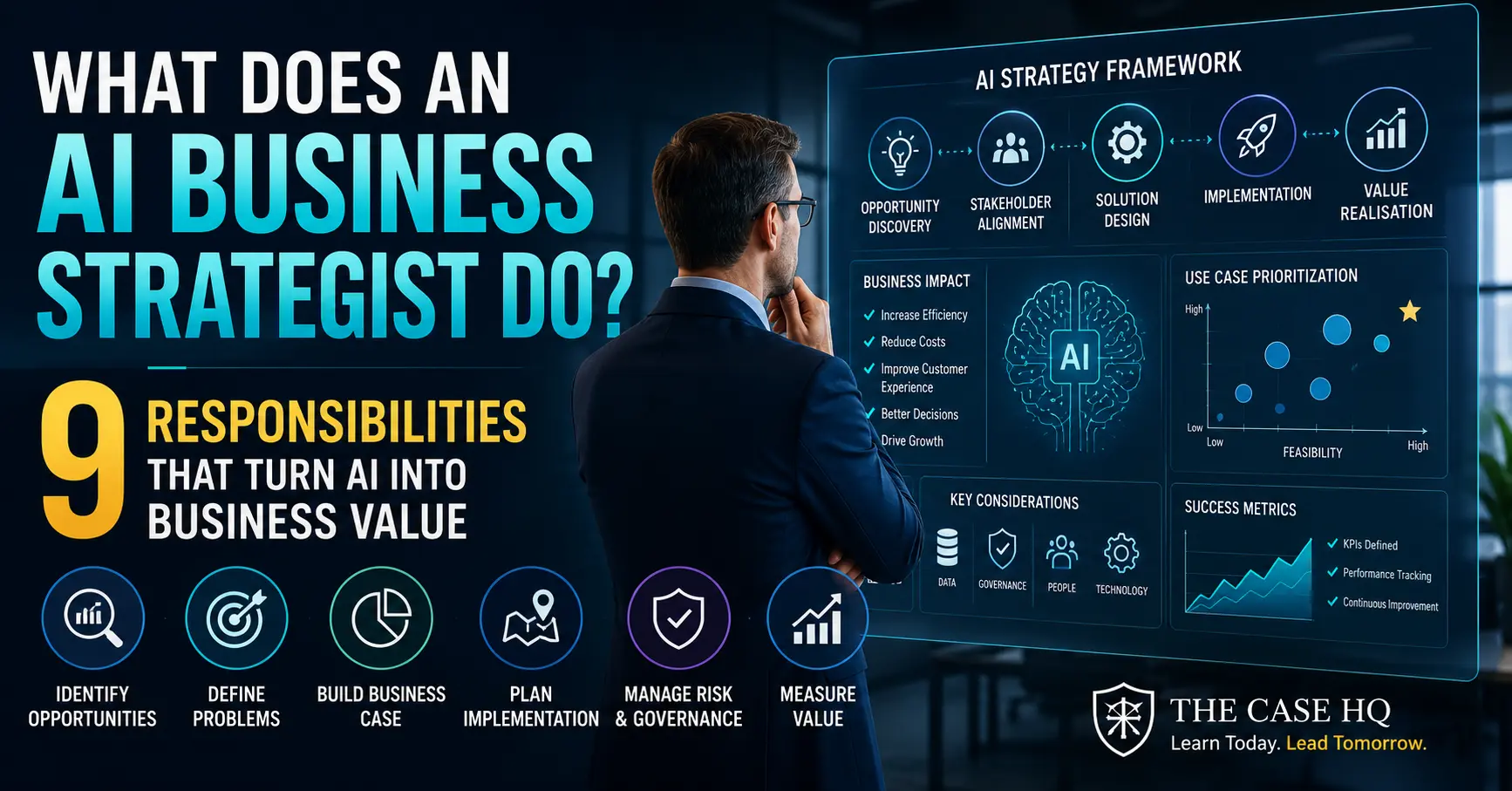
What does an AI business strategist do? An AI business strategist identifies where artificial intelligence can create genuine organisational value, evaluates whether proposed applications are viable, and helps convert promising ideas into practical strategies, business cases and implementation plans.
The role does not primarily involve programming AI models. It connects business priorities, operational challenges, data capabilities, responsible governance and implementation decisions. This makes the AI business strategist particularly relevant to organisations that want to use AI effectively but need stronger direction before investing in technology.
Table of contents
- What is an AI business strategist?
- What does an AI business strategist do?
- Responsibility 1: Identify valuable AI opportunities
- Responsibility 2: Define the business problem
- Responsibility 3: Evaluate organisational readiness
- Responsibility 4: Build the AI business case
- Responsibility 5: Prioritise AI use cases
- Responsibility 6: Develop an AI implementation roadmap
- Responsibility 7: Connect business and technical teams
- Responsibility 8: Address AI governance and risk
- Responsibility 9: Measure AI value
- What does an AI business strategist do each day?
- Essential AI business strategist skills
- AI business strategist versus related roles
- Industries that need AI business strategists
- How to become an AI business strategist
- Is AI business strategy suitable for non-technical professionals?
- Common mistakes AI business strategists must avoid
- Final perspective
- Frequently asked question
What is an AI business strategist?
An AI business strategist is a professional who helps an organisation make informed decisions about where, why and how artificial intelligence should be used.
The strategist operates between organisational strategy and technical delivery. Rather than beginning with a particular AI platform, the role begins with questions about business needs, operational performance and stakeholder priorities.
An AI business strategist may work internally as part of a strategy, innovation, digital transformation, operations or technology function. The role may also be performed by an external consultant advising organisations on AI opportunities, investment decisions and implementation.
The position can appear under several job titles, including:
- AI strategy consultant
- AI transformation manager
- AI business adviser
- AI programme strategist
- Digital strategy manager
- AI implementation consultant
- Business transformation lead
- AI innovation manager
The precise title varies, but the central purpose remains similar: ensure that AI activity supports meaningful organisational objectives rather than becoming an isolated technical experiment.
The Certified AI Business Strategist course develops this strategic, non-technical perspective by focusing on how professionals can connect AI capabilities with business priorities, implementation and measurable outcomes.
Responsibility 1: Identify valuable AI opportunities
The first responsibility is to identify where AI could make a meaningful difference.
Organisations often approach this task incorrectly. They begin with a technology and ask where it can be used. An AI business strategist reverses that process by examining business problems before selecting a solution.
Potential opportunities may involve:
- Reducing repetitive work
- Improving forecasting
- Accelerating document review
- Supporting customer service
- Detecting unusual transactions
- Improving resource allocation
- Personalising services
- Strengthening quality control
- Supporting employee decision-making
- Identifying patterns in large datasets
However, the presence of a repetitive or data-intensive process does not automatically justify AI.
The strategist must determine whether the opportunity is sufficiently valuable, feasible and appropriate.
Questions used to assess an opportunity
A strategist may ask:
- What is the current problem?
- Who experiences the problem?
- How frequently does it occur?
- What is its financial or operational impact?
- How is the process handled today?
- What data are available?
- Could a simpler solution work?
- What decision would AI improve?
- What could go wrong?
- How would success be measured?
This analysis prevents the organisation from implementing AI merely because competitors are discussing it.
Practical example
A university may propose an AI system to identify students at risk of disengagement.
The strategist would not begin by selecting software. The strategist would first determine:
- What “at risk” means
- Which student outcomes matter
- Whether reliable historical data exist
- How staff currently recognise disengagement
- Whether an alert would lead to effective intervention
- Which students might be incorrectly classified
- Who would review the system’s recommendation
- How privacy would be protected
The opportunity becomes credible only when the business need, intervention process and governance requirements are clear.
Responsibility 2: Define the business problem
Many AI projects fail before implementation because the organisation has not defined the problem precisely.
Statements such as “we need AI in customer service” or “we should automate recruitment” are ambitions, not problem definitions.
An AI business strategist converts a broad ambition into a structured problem.
A clear problem statement should explain
- The current situation
- The affected stakeholders
- The performance gap
- The organisational consequences
- The evidence available
- The desired improvement
- The boundaries of the initiative
For example:
Customer-service employees spend an average of four hours each week searching several systems for policy information, increasing response times and creating inconsistent answers.
This statement is more useful than:
We need an AI chatbot.
The clearer statement allows the organisation to compare several possible responses. These might include improved knowledge management, process redesign, search technology, employee training or an AI assistant.
The strategist’s responsibility is not to prove that AI is always the correct answer. It is to help the organisation choose the most appropriate response.
Why this responsibility matters
Poor problem definition causes several difficulties:
- Technology is selected too early.
- Benefits remain vague.
- Project scope expands uncontrollably.
- Teams disagree about expected outcomes.
- Relevant data are overlooked.
- Performance cannot be measured accurately.
- Stakeholders resist the initiative because its purpose is unclear.
A strong strategist creates a common understanding before substantial investment begins.
Responsibility 3: Evaluate organisational readiness
An attractive AI opportunity can still fail when the organisation is not ready to implement it.
An AI business strategist therefore assesses whether the necessary conditions exist.
Data readiness
The strategist examines:
- Data availability
- Data quality
- Data ownership
- Data consistency
- Access permissions
- Privacy limitations
- Historical coverage
- Missing or biased data
AI cannot correct every weakness in the underlying information. Poor data may produce unreliable recommendations, distorted outputs or excessive implementation costs.
Technology readiness
The strategist may consider:
- Existing systems
- Integration requirements
- Cloud or infrastructure capacity
- Cybersecurity controls
- Identity and access management
- Vendor compatibility
- Monitoring capability
- Technical support
The strategist does not need to design the technical architecture independently. However, the role must ensure that technical dependencies are recognised before commitments are made.
Workforce readiness
An organisation may have suitable data and technology but lack the people required to use the system effectively.
Questions include:
- Do employees understand the purpose?
- Who will review AI-generated outputs?
- What new skills are required?
- Which roles will change?
- Are managers prepared to lead adoption?
- Is there anxiety or resistance?
- Who will provide training and support?
Governance readiness
The organisation should also consider:
- AI policies
- Decision rights
- Risk assessment procedures
- Legal review
- Procurement standards
- Human oversight
- Documentation
- Incident escalation
- Performance monitoring
A readiness assessment may conclude that the organisation should proceed, delay implementation or begin with a smaller pilot.
That is a valuable outcome. Preventing a poorly prepared investment can be as important as identifying a promising one.
Responsibility 4: Build the AI business case
An AI business case explains why an initiative deserves investment.
The case should connect the proposed application with measurable organisational value. It should also acknowledge uncertainty rather than presenting optimistic assumptions as guaranteed results.
Elements of an AI business case
A robust business case may include:
- The business problem
- Strategic alignment
- Proposed use case
- Intended users
- Expected benefits
- Implementation costs
- Data requirements
- Technology requirements
- Workforce implications
- Principal risks
- Alternative solutions
- Pilot design
- Success measures
- Decision points
- Scaling conditions
Benefits may be financial or non-financial
Possible benefits include:
- Increased revenue
- Reduced operational cost
- Shorter processing time
- Fewer errors
- Improved customer experience
- Faster analysis
- Better forecasting
- Stronger compliance
- Improved employee productivity
- Reduced risk exposure
The strategist must distinguish between benefits that can be measured directly and benefits that require indirect indicators.
For example, an AI-supported knowledge assistant may reduce average handling time, but it may also improve employee confidence and service consistency. Different measures will be needed for each outcome.
Costs should be considered broadly
AI costs are not limited to software licences.
The business case may need to include:
- Data preparation
- Integration
- External consultancy
- Staff training
- Change management
- Governance
- Testing
- Cybersecurity
- Monitoring
- Vendor management
- System updates
- Human review
A cheap subscription can become an expensive initiative when the organisation overlooks these supporting requirements.
Responsibility 5: Prioritise AI use cases
Organisations frequently identify more AI opportunities than they can implement.
The AI business strategist helps compare and prioritise them.
A practical prioritisation framework
Use cases may be assessed against criteria such as:
| Criterion | Strategic question |
|---|---|
| Strategic alignment | Does the use case support an important organisational priority? |
| Business value | Could it create a meaningful improvement? |
| Data readiness | Are reliable and appropriate data available? |
| Technical feasibility | Can it be implemented with available capabilities? |
| Risk | What could harm customers, employees or the organisation? |
| Implementation effort | How much time, funding and coordination are required? |
| Adoption readiness | Will intended users incorporate it into their work? |
| Time to value | How quickly can credible evidence be produced? |
| Scalability | Could the capability be extended after a successful pilot? |
The strategist can score use cases, but the score should support judgement rather than replace it.
A use case with high financial value may still be unsuitable if it creates unacceptable legal, ethical or reputational risk. A modest use case may be valuable as an early pilot because it enables learning without exposing the organisation to severe consequences.
Portfolio balance
The strategist may recommend a balanced portfolio containing:
- Quick operational improvements
- Controlled experiments
- Strategic long-term initiatives
- Capability-building projects
- Risk-reduction applications
This is more credible than pursuing only highly visible generative AI projects.
Responsibility 6: Develop an AI implementation roadmap
An approved business case is not yet an implementation plan.
The strategist helps convert the decision into a sequence of manageable activities.
A practical AI roadmap may include
Stage 1: Discovery
- Confirm the business problem
- Identify stakeholders
- Review existing evidence
- Assess data
- Compare solution options
Stage 2: Design
- Define the use case
- Set boundaries
- Clarify responsibilities
- Establish governance
- Select measures
- Prepare procurement or development requirements
Stage 3: Pilot
- Test with a controlled user group
- Monitor performance
- Record errors
- Gather user feedback
- Review operational impact
- Assess emerging risks
Stage 4: Evaluation
- Compare results with the baseline
- Determine whether benefits are credible
- Examine unintended consequences
- Identify implementation weaknesses
- Decide whether to scale, modify or stop
Stage 5: Scaling
- Extend the user group
- Integrate with wider systems
- Formalise training
- Strengthen support
- Establish continuing monitoring
- Review governance arrangements
The strategist ensures that the roadmap includes decision gates rather than assuming that every pilot must become a permanent system.
Responsibility 7: Connect business and technical teams
One of the most important responsibilities is translation.
Business stakeholders may describe goals without understanding technical constraints. Technical teams may explain model performance without connecting it clearly to organisational outcomes.
The AI business strategist helps both groups work from a shared understanding.
Translating business needs
The strategist helps technical teams understand:
- The problem being solved
- The intended users
- The operational context
- The consequences of error
- The required level of accuracy
- The acceptable response time
- The governance requirements
- The expected business value
Translating technical information
The strategist helps business leaders understand:
- What the system can and cannot do
- Why particular data are required
- How performance will be evaluated
- Why outputs may be uncertain
- Which decisions require human review
- What integration is necessary
- How vendor dependency may affect the organisation
- Why continuing monitoring is required
Preventing communication failure
Without this translation, teams may appear to agree while working towards different outcomes.
For example, a technical team may optimise a model for statistical accuracy while the business requires a system that reduces processing time without increasing customer complaints.
The strategist makes these expectations explicit.
Responsibility 8: Address AI governance and risk
AI strategy is incomplete when it discusses opportunity without responsibility.
An AI business strategist should identify the governance and risk implications of a proposed use case before implementation.
Areas requiring attention
These may include:
- Privacy
- Cybersecurity
- Reliability
- Fairness
- Transparency
- Explainability
- Intellectual property
- Human oversight
- Regulatory compliance
- Vendor accountability
- Data provenance
- Reputational impact
The official NIST AI Risk Management Framework is intended to help organisations incorporate trustworthiness considerations into the design, development, use and evaluation of AI systems. NIST organises the core framework around Govern, Map, Measure and Manage, linking governance with contextual understanding, assessment and continuing risk management.
The strategist does not necessarily own every governance decision. Legal, risk, cybersecurity, data and compliance specialists may hold formal responsibilities. However, the strategist should ensure that these functions are engaged early enough to influence the design.
Example: AI in recruitment
An organisation may wish to use AI to screen job applicants.
The strategist should investigate:
- What decisions the system influences
- Which data it uses
- Whether historical data reflect past bias
- How applicants are informed
- Whether candidates can challenge a decision
- What level of human review exists
- How performance is tested across groups
- Who is accountable when errors occur
Ignoring these questions can turn an efficiency project into a legal and reputational problem.
Responsibility 9: Measure AI value
An AI initiative should not be judged by whether it was launched.
The strategist helps establish whether it creates value after implementation.
Measures should connect with the original problem
If the problem concerned slow service, relevant measures may include:
- Average response time
- Resolution time
- First-contact resolution
- Escalation rate
- Customer satisfaction
- Employee workload
If the problem concerned forecasting, measures may include:
- Forecast accuracy
- Inventory availability
- Waste
- Expedited shipping costs
- Stock-outs
- Planning time
Different forms of AI performance
The strategist may distinguish among:
Technical performance
- Accuracy
- Precision
- Recall
- Error rate
- Response time
Operational performance
- Cycle time
- Cost
- Productivity
- Service consistency
- Process completion
User performance
- Adoption
- Satisfaction
- Confidence
- Override rate
- Training completion
Risk performance
- Harmful outputs
- Security incidents
- Complaints
- Bias indicators
- Escalations
- Policy exceptions
Strategic performance
- Revenue contribution
- Customer retention
- Innovation capacity
- Market responsiveness
- Organisational capability
A technically impressive system can still fail operationally if employees do not trust it or if it creates more review work than it removes.
The strategist therefore evaluates the complete outcome rather than one model statistic.
What does an AI business strategist do each day?
There is no single daily routine because the role changes across projects and organisations.
A typical week may involve:
- Meeting functional leaders to understand business challenges
- Reviewing operational performance data
- Mapping business processes
- Evaluating AI use cases
- Conducting readiness assessments
- Preparing business cases
- Comparing vendor proposals
- Working with data and technology teams
- Facilitating risk discussions
- Developing implementation roadmaps
- Presenting recommendations
- Monitoring pilot results
- Updating senior stakeholders
Example working day
A strategist might begin the day by meeting an operations director who wants to automate quality inspections.
The strategist may then review existing defect data with a quality manager, discuss image requirements with a technical specialist and identify risks with the compliance team.
Later, the strategist may prepare a use-case assessment comparing AI-enabled inspection with process redesign and improved employee training.
The day could end with a presentation to a steering committee recommending a limited pilot rather than immediate organisation-wide deployment.
The work therefore combines analysis, communication, facilitation and judgement.
Essential AI business strategist skills
The role requires a combination of business, analytical, technological and interpersonal skills.
1. Strategic thinking
The strategist must connect individual opportunities with wider organisational priorities.
This requires the ability to distinguish between interesting applications and strategically important ones.
2. Business analysis
The role needs strong problem definition, process analysis, stakeholder analysis and requirements clarification.
3. AI literacy
The strategist should understand major AI capabilities, limitations and terminology without necessarily becoming an engineer.
4. Financial judgement
Business cases require an understanding of costs, benefits, investment assumptions and value realisation.
5. Data literacy
The strategist should be able to question data quality, availability, ownership and relevance.
6. Risk awareness
AI opportunities must be considered alongside privacy, security, fairness, reliability and accountability.
7. Communication
The strategist needs to explain complex ideas clearly to technical and non-technical stakeholders.
8. Facilitation
AI decisions often involve competing perspectives. The strategist may need to guide workshops, clarify disagreements and establish common priorities.
9. Change management
Implementation may alter roles, processes and expectations. The strategist should understand how adoption is supported.
10. Sector knowledge
AI strategy becomes more credible when the professional understands the industry, customers, operating model and regulatory environment.
The World Economic Forum’s Future of Jobs Report 2025, based on input from more than 1,000 employers, identifies AI and big data among the fastest-growing skills while also emphasising the continuing importance of human capabilities such as analytical thinking, leadership and collaboration. This combination closely reflects the multidisciplinary nature of AI business strategy.
AI business strategist versus related roles
The role overlaps with several positions but remains distinct.
AI business strategist versus data scientist
A data scientist typically develops, evaluates or applies analytical and machine-learning models.
An AI business strategist determines why an organisation should pursue a use case, how it supports strategy and how it should be implemented.
The strategist may work closely with data scientists but does not replace them.
AI business strategist versus project manager
A project manager coordinates delivery against an agreed scope, schedule and resource plan.
The strategist helps determine whether the project should exist, what value it should create and how it fits organisational priorities.
One professional may perform both roles in a smaller initiative.
AI business strategist versus business analyst
A business analyst focuses on requirements, processes and stakeholder needs.
An AI business strategist applies similar analysis at a broader strategic level, with particular attention to AI value, readiness, governance and implementation.
AI business strategist versus AI product manager
An AI product manager commonly owns the continuing development and performance of an AI-enabled product.
The strategist may work earlier in the lifecycle by evaluating opportunities, developing the business case and shaping the implementation direction.
AI business strategist versus Chief AI Officer
The AI business strategist usually focuses on selected opportunities, functions or programmes.
The Chief AI Officer directs AI at enterprise level, including governance, portfolio priorities, organisational capability and executive accountability.
Professionals preparing for enterprise-level responsibility may later progress to the Certified Chief AI Officer course
Industries that need AI business strategists
AI business strategy is relevant wherever organisations need to connect technology with operational and strategic decisions.
Financial services
Possible areas include:
- Fraud detection
- Risk assessment
- Customer service
- Credit analysis
- Compliance monitoring
- Document processing
Healthcare
Possible areas include:
- Scheduling
- Clinical documentation
- Resource planning
- Patient communication
- Decision support
- Operational forecasting
Education
Possible areas include:
- Student support
- Learning analytics
- Assessment
- Curriculum planning
- Administrative automation
- Research assistance
Manufacturing
Possible areas include:
- Predictive maintenance
- Quality inspection
- Demand planning
- Production scheduling
- Supply-chain monitoring
Human resources
Possible areas include:
- Workforce planning
- Skills analysis
- Learning recommendations
- Employee support
- Talent analytics
Retail
Possible areas include:
- Demand forecasting
- Inventory optimisation
- Personalisation
- Pricing
- Customer service
- Fraud prevention
Professional services
Possible areas include:
- Research
- Document analysis
- Knowledge management
- Proposal development
- Client service
- Workflow automation
The strategist’s contribution is not to apply the same technology everywhere. It is to understand the context well enough to decide which applications are appropriate.
How to become an AI business strategist
There is no single entry route.
Professionals often move into AI strategy from:
- Management
- Consulting
- Business analysis
- Digital transformation
- Operations
- Project management
- Marketing
- Human resources
- Finance
- Technology management
- Data analysis
- Innovation
Step 1: Build business understanding
Learn how organisations create value, make decisions and manage performance.
A strategist who understands AI but not business will struggle to develop credible recommendations.
The Certified Business Functions Explorer course can support professionals who need a broader understanding of how major organisational functions work together.
Step 2: Develop practical AI literacy
Learn:
- What different AI approaches can do
- What they cannot do
- What data they require
- Where errors arise
- Why human oversight matters
- How systems are monitored
The objective is informed judgement, not coding proficiency.
Step 3: Learn use-case evaluation
Practise converting broad ideas into structured assessments covering value, feasibility, readiness and risk.
Step 4: Build business-case capability
Learn to quantify benefits, identify costs, test assumptions and present recommendations.
Step 5: Understand governance
Study privacy, security, fairness, accountability, vendor risk and responsible implementation.
Step 6: Gain practical experience
Apply the knowledge through:
- Internal improvement projects
- Pilot proposals
- Consulting assignments
- Process assessments
- AI readiness reviews
- Volunteer projects
- Portfolio case studies
Step 7: Build a professional portfolio
A useful portfolio may include:
- An AI opportunity map
- A use-case assessment
- A business case
- A readiness assessment
- A pilot roadmap
- A governance checklist
- A value measurement framework
Step 8: Complete structured professional development
The Certified AI Business Strategist course provides a structured route for professionals seeking to build AI strategy, implementation and governance capability from a business perspective.
Is AI business strategy suitable for non-technical professionals?
Yes. The role can be particularly suitable for non-technical professionals who understand business functions, customers, employees, regulation or operations.
The strategist does not usually need to develop algorithms. However, the role requires sufficient technical awareness to question assumptions and work effectively with specialists.
A non-technical strategist should be able to ask:
- What data does the system use?
- How was performance tested?
- What happens when the system is wrong?
- Who reviews the output?
- Can the organisation explain the decision?
- How will performance be monitored?
- What is the vendor responsible for?
- Can the system be integrated securely?
- What data leave the organisation?
- How can the system be stopped or replaced?
The professional value comes from combining this awareness with business judgement.
Common mistakes AI business strategists must avoid
Starting with a tool
A tool should be selected after the problem and requirements are understood.
Treating every automation opportunity as AI
Some processes need redesign, clearer rules or conventional software rather than AI.
Ignoring data weaknesses
A compelling use case cannot compensate for unsuitable data.
Promising guaranteed returns
AI benefits should be tested through controlled evidence rather than exaggerated forecasts.
Separating strategy from governance
Risk and accountability should influence the strategy from the beginning.
Underestimating employee adoption
A system produces no value when intended users avoid it, misunderstand it or cannot integrate it into their work.
Allowing pilots to continue indefinitely
Every pilot should have clear decision criteria and an expected conclusion.
Measuring activity instead of value
Launching an AI tool, training employees or producing outputs does not prove that the business problem has improved.
Assuming vendors have answered every question
Vendor demonstrations should be tested against organisational requirements, risks and evidence.
Final perspective
An AI business strategist helps an organisation move from enthusiasm about artificial intelligence to disciplined decisions about value, feasibility, governance and implementation.
The role identifies promising opportunities, defines business problems, assesses readiness, develops business cases, prioritises use cases and builds practical roadmaps.
It also connects technical and non-technical stakeholders, ensures that risks are considered early and establishes how value will be measured.
This makes the role relevant to managers, consultants, business analysts, transformation professionals and functional leaders who want to contribute to AI adoption without becoming software developers.
Professionals who want to build these capabilities can explore the Certified AI Business Strategist course, which focuses on connecting AI with business strategy, organisational implementation and responsible leadership.
The most effective AI business strategist is not the person who recommends the greatest number of AI tools. It is the person who helps the organisation make better decisions about where AI should—and should not—be used.
Frequently asked questions
What does an AI business strategist do?
An AI business strategist identifies valuable AI opportunities, defines business problems, assesses readiness, develops business cases, plans implementation and helps measure organisational value.
Does an AI business strategist need to code?
Not usually. The role requires AI and data literacy, but it primarily focuses on business strategy, implementation, communication and governance.
Is AI business strategy a technical role?
It is a technology-related business role rather than a purely technical position. The strategist works with technical specialists while concentrating on organisational decisions and outcomes.
What skills does an AI business strategist need?
Important skills include strategic thinking, business analysis, AI literacy, financial judgement, data literacy, communication, stakeholder management, risk awareness and change management.
What is the difference between an AI strategist and a data scientist?
A data scientist usually develops or evaluates analytical models. An AI strategist determines where AI can create business value and how an initiative should be justified, governed and implemented.
Can a manager become an AI business strategist?
Yes. Managers from operations, HR, marketing, finance, education, supply chains and other functions can move into AI strategy by combining their sector expertise with AI literacy and strategic implementation skills.
Is AI business strategy suitable for consultants?
Yes. Consultants can use AI strategy capability to assess organisational needs, identify opportunities, develop roadmaps and advise clients on responsible implementation.
What should an AI business strategy course include?
A credible course should address AI concepts, use-case assessment, business cases, readiness, strategic alignment, implementation planning, governance, stakeholder communication and value measurement.
Can an AI business strategist become a Chief AI Officer?
Potentially. AI strategy experience can provide a foundation for broader enterprise responsibility, although a Chief AI Officer also requires governance, portfolio management and senior leadership capability.
Does certification guarantee an AI strategy job?
No. Certification can support professional development, but employers also consider experience, sector knowledge, evidence of application and leadership capability.
Responses