
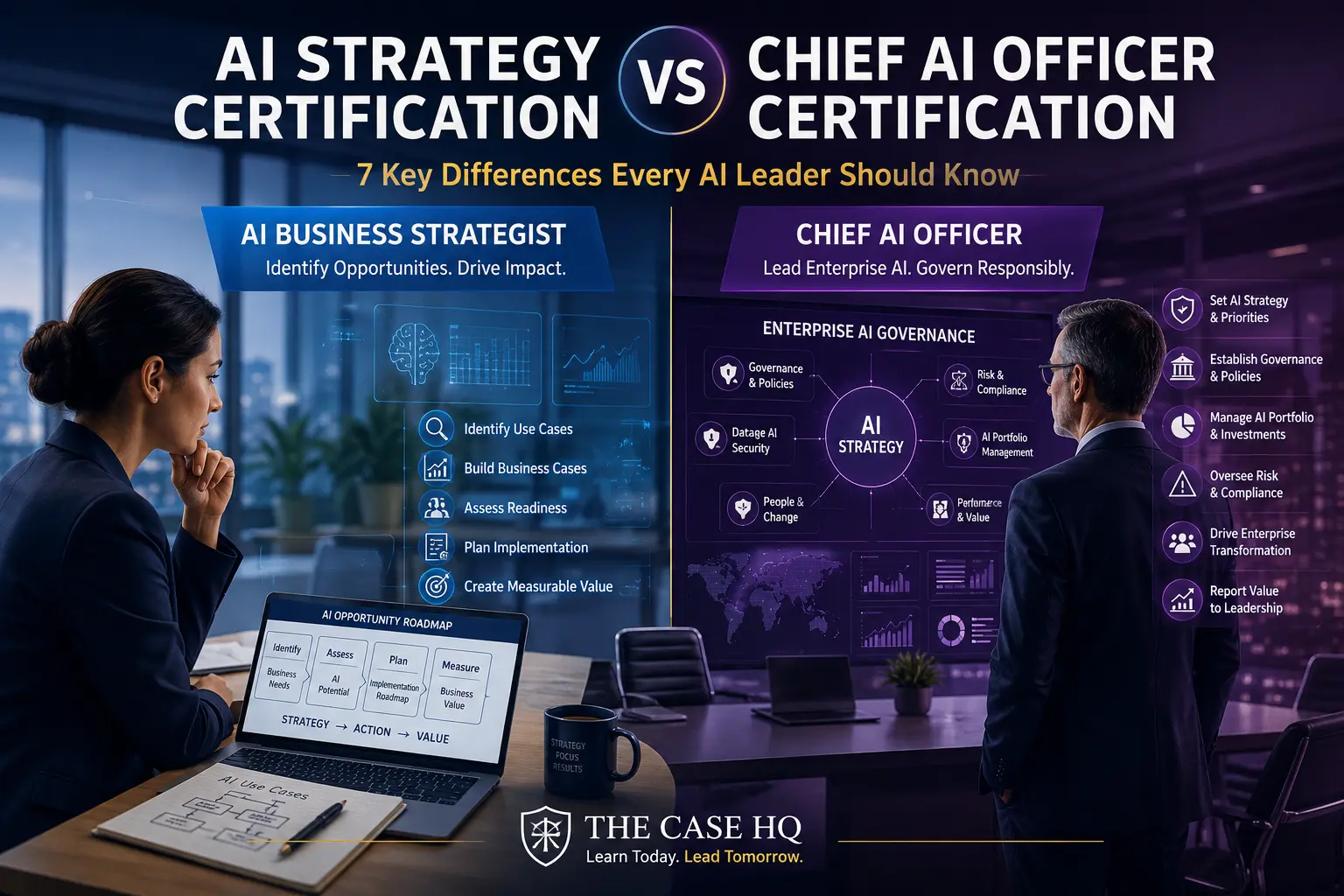
AI strategy certification vs Chief AI Officer certification is not simply a comparison between two professional course titles. One pathway prepares professionals to identify, evaluate and implement valuable AI opportunities. The other develops the enterprise leadership needed to govern, prioritise and scale artificial intelligence across an organisation.
Both pathways can strengthen AI leadership capability, particularly for professionals who do not intend to become programmers or data scientists. However, they serve different career stages, decision-making responsibilities and organisational needs.
This guide compares the two certifications across seven practical areas so that you can select the pathway that fits your current role and future ambitions.
Table of contents
- AI strategy certification vs Chief AI Officer certification at a glance
- Difference 1: Strategic scope
- Difference 2: Organisational responsibility
- Difference 3: Curriculum and capabilities
- Difference 4: Governance and risk
- Difference 5: Implementation and portfolio oversight
- Difference 6: Suitable career stage
- Difference 7: Professional outcomes
- Which certification is suitable for non-technical professionals?
- How AI strategists and Chief AI Officers work together
- How to choose the right certification
- Can you complete both certifications?
- Final recommendation
- Frequently asked questions
AI strategy certification vs Chief AI Officer certification at a glance
The most important difference concerns the scale of responsibility.
An AI business strategist generally focuses on how artificial intelligence can solve specific business problems, support strategic priorities or improve organisational performance. The strategist may identify use cases, assess readiness, construct business cases and develop implementation roadmaps.
A Chief AI Officer operates at enterprise level. The role is concerned with how the organisation establishes AI priorities, allocates resources, governs risks, coordinates initiatives and holds leaders accountable for results.
| Choose AI strategy certification when you need to… | Choose Chief AI Officer certification when you need to… |
|---|---|
| Identify valuable AI opportunities | Set enterprise-wide AI direction |
| Develop AI business cases | Establish AI governance |
| Assess organisational readiness | Oversee multiple AI initiatives |
| Plan functional implementation | Prioritise enterprise investment |
| Advise managers or clients | Coordinate executive stakeholders |
| Connect business needs with AI capabilities | Report AI value and risk to senior leadership |
The distinction is not always rigid. A smaller organisation may expect one person to perform both sets of responsibilities. In a large organisation, several AI strategists may work within a transformation or AI office led by a Chief AI Officer.
Difference 1: Strategic scope
The focus of an AI business strategist
An AI business strategist works at the point where business priorities and AI capabilities meet.
The role begins with a business problem, not with a particular technology. The strategist examines whether artificial intelligence is an appropriate response, what value it could create and what conditions would be required for successful implementation.
Typical questions include:
- What problem are we trying to solve?
- Why is the existing process insufficient?
- Could conventional automation or analytics solve it more simply?
- What data would an AI system require?
- Which stakeholders would be affected?
- What benefits could the organisation realistically expect?
- What risks or dependencies could prevent success?
- How should a pilot be designed and evaluated?
An AI strategist may focus on one function, programme, service line or client engagement. For example, the strategist might examine the use of AI in customer service, procurement, human resources, supply-chain planning or financial forecasting.
The Certified AI Business Strategist course is intended for professionals who want to connect AI capabilities with business strategy without concentrating on coding or algorithm development.
The focus of a Chief AI Officer
A Chief AI Officer considers AI across the entire organisation.
The CAIO is concerned not only with whether an individual project is viable, but also with how different AI initiatives collectively support enterprise strategy.
Typical questions include:
- Which AI capabilities should the organisation prioritise?
- How much should the organisation invest?
- Which initiatives should be piloted, scaled, revised or stopped?
- Who owns each AI system?
- How should risks be classified and escalated?
- What governance structure is required?
- How will AI performance be reported?
- Where should AI expertise sit within the organisation?
- How should the workforce be prepared for AI-enabled change?
The Certified Chief AI Officer course addresses the broader strategic, governance and executive responsibilities associated with enterprise AI leadership.
Practical example
Consider a healthcare organisation exploring an AI-supported appointment scheduling system.
An AI business strategist might:
- Analyse the existing scheduling problem.
- Estimate the operational and patient impact of delays.
- determine whether AI is appropriate.
- Assess data availability and quality.
- Develop a pilot business case.
- Identify implementation risks.
- Propose performance indicators.
A Chief AI Officer might:
- Determine whether the initiative fits enterprise AI priorities.
- Confirm governance and accountability.
- Coordinate data, legal, clinical and technology leaders.
- Set requirements for human oversight.
- Review whether the vendor meets organisational standards.
- Compare the initiative with competing AI investments.
- Decide whether successful results justify wider adoption.
The strategist shapes the opportunity. The CAIO decides how the opportunity fits within the organisation’s wider AI system.
Difference 1: Strategic scope
The focus of an AI business strategist
An AI business strategist works at the point where business priorities and AI capabilities meet.
The role begins with a business problem, not with a particular technology. The strategist examines whether artificial intelligence is an appropriate response, what value it could create and what conditions would be required for successful implementation.
Typical questions include:
- What problem are we trying to solve?
- Why is the existing process insufficient?
- Could conventional automation or analytics solve it more simply?
- What data would an AI system require?
- Which stakeholders would be affected?
- What benefits could the organisation realistically expect?
- What risks or dependencies could prevent success?
- How should a pilot be designed and evaluated?
An AI strategist may focus on one function, programme, service line or client engagement. For example, the strategist might examine the use of AI in customer service, procurement, human resources, supply-chain planning or financial forecasting.
The Certified AI Business Strategist course is intended for professionals who want to connect AI capabilities with business strategy without concentrating on coding or algorithm development.
The focus of a Chief AI Officer
A Chief AI Officer considers AI across the entire organisation.
The CAIO is concerned not only with whether an individual project is viable, but also with how different AI initiatives collectively support enterprise strategy.
Typical questions include:
- Which AI capabilities should the organisation prioritise?
- How much should the organisation invest?
- Which initiatives should be piloted, scaled, revised or stopped?
- Who owns each AI system?
- How should risks be classified and escalated?
- What governance structure is required?
- How will AI performance be reported?
- Where should AI expertise sit within the organisation?
- How should the workforce be prepared for AI-enabled change?
The Certified Chief AI Officer course addresses the broader strategic, governance and executive responsibilities associated with enterprise AI leadership.
Practical example
Consider a healthcare organisation exploring an AI-supported appointment scheduling system.
An AI business strategist might:
- Analyse the existing scheduling problem.
- Estimate the operational and patient impact of delays.
- determine whether AI is appropriate.
- Assess data availability and quality.
- Develop a pilot business case.
- Identify implementation risks.
- Propose performance indicators.
A Chief AI Officer might:
- Determine whether the initiative fits enterprise AI priorities.
- Confirm governance and accountability.
- Coordinate data, legal, clinical and technology leaders.
- Set requirements for human oversight.
- Review whether the vendor meets organisational standards.
- Compare the initiative with competing AI investments.
- Decide whether successful results justify wider adoption.
The strategist shapes the opportunity. The CAIO decides how the opportunity fits within the organisation’s wider AI system.
Difference 2: Organisational responsibility
An AI strategist is commonly responsible for developing recommendations, frameworks, roadmaps or implementation plans. The strategist may influence major decisions without holding final enterprise authority.
A Chief AI Officer normally has broader accountability. Depending on the organisation, that accountability may include:
- Enterprise AI strategy
- AI governance
- Investment prioritisation
- Risk oversight
- Cross-functional coordination
- AI capability development
- Executive reporting
- Performance monitoring
- External partnerships
- Regulatory readiness
The difference can be understood through three levels.
Project level
At project level, the emphasis is on delivering a defined AI use case. A project manager, product owner or technical lead may coordinate the work.
Strategic programme level
At programme level, an AI strategist may connect several activities, evaluate business value and ensure that implementation supports organisational priorities.
Enterprise level
At enterprise level, the Chief AI Officer considers the collective value, risk and direction of all significant AI initiatives.
This does not mean that the CAIO personally manages every project. The role establishes the decision architecture through which those projects are selected, governed and reviewed.
Difference 4: Governance and risk
Governance is relevant to both pathways, but the level of responsibility differs.
The strategist applies governance
An AI business strategist should incorporate existing governance requirements into the development of an initiative.
For example, the strategist may need to determine:
- Whether personal or confidential data will be used
- Whether human review is necessary
- Whether the proposed system could disadvantage particular groups
- Whether outputs can be explained
- Whether vendor claims can be verified
- Whether the organisation can monitor performance after deployment
- Who will be responsible for correcting errors
The strategist does not treat governance as a final approval exercise. Risk considerations should influence whether the initiative is selected and how it is designed.
The CAIO establishes governance
The Chief AI Officer is more likely to design or oversee the enterprise governance model itself.
This may include:
- AI policies
- Approval authorities
- Risk classifications
- Governance committees
- System inventories
- Documentation standards
- Vendor requirements
- Human-oversight rules
- Performance monitoring
- Incident escalation
- Audit arrangements
- Retirement procedures
The official NIST AI Risk Management Framework organises AI risk management around four functions: Govern, Map, Measure and Manage. This reinforces the need to connect organisational governance with contextual assessment, evaluation and continuing risk management rather than relying on a one-time technical review.
The AI Principles similarly emphasise innovative and trustworthy AI, including human-centred values, transparency, robustness and accountability. These principles were updated in 2024 to reflect developments such as general-purpose and generative AI.
A strategist needs to understand how these expectations affect an individual proposal. A CAIO needs to translate them into enterprise responsibilities, controls and decision processes.
Difference 5: Implementation and portfolio oversight
AI strategy focuses on moving from idea to action
Many organisations have lists of possible AI applications. Far fewer have a disciplined way to decide which ideas deserve investment.
An AI strategist may lead or support a process such as:
- Define the business problem.
- Examine current performance.
- Identify potential AI applications.
- assess data and operational readiness.
- Compare AI with alternative solutions.
- Develop a business case.
- Design a controlled pilot.
- Select performance measures.
- Review evidence from the pilot.
- Recommend whether to scale, modify or stop.
The focus is practical implementation.
CAIO leadership focuses on the portfolio
The CAIO looks across multiple initiatives and asks whether the organisation is investing coherently.
A portfolio may contain:
- Customer-service assistants
- Fraud-detection systems
- Predictive maintenance
- Recruitment tools
- Demand forecasting
- Personalisation systems
- Document-processing applications
- Generative AI assistants
- Decision-support tools
Each initiative may appear useful in isolation. Collectively, however, they can create duplicated investment, inconsistent controls and fragmented accountability.
The CAIO may therefore examine:
- Strategic alignment
- Expected value
- Technical dependencies
- Data requirements
- Risk classification
- Workforce impact
- Investment level
- Time to value
- Organisational capacity
- Opportunities for reuse
- Evidence from pilots
This portfolio perspective is one of the clearest differences between the two certification pathways.
Difference 5: Implementation and portfolio oversight
AI strategy focuses on moving from idea to action
Many organisations have lists of possible AI applications. Far fewer have a disciplined way to decide which ideas deserve investment.
An AI strategist may lead or support a process such as:
- Define the business problem.
- Examine current performance.
- Identify potential AI applications.
- assess data and operational readiness.
- Compare AI with alternative solutions.
- Develop a business case.
- Design a controlled pilot.
- Select performance measures.
- Review evidence from the pilot.
- Recommend whether to scale, modify or stop.
The focus is practical implementation.
CAIO leadership focuses on the portfolio
The CAIO looks across multiple initiatives and asks whether the organisation is investing coherently.
A portfolio may contain:
- Customer-service assistants
- Fraud-detection systems
- Predictive maintenance
- Recruitment tools
- Demand forecasting
- Personalisation systems
- Document-processing applications
- Generative AI assistants
- Decision-support tools
Each initiative may appear useful in isolation. Collectively, however, they can create duplicated investment, inconsistent controls and fragmented accountability.
The CAIO may therefore examine:
- Strategic alignment
- Expected value
- Technical dependencies
- Data requirements
- Risk classification
- Workforce impact
- Investment level
- Time to value
- Organisational capacity
- Opportunities for reuse
- Evidence from pilots
This portfolio perspective is one of the clearest differences between the two certification pathways.
Difference 6: Suitable career stage
Career stage matters, but job title alone should not determine the choice.
Early-career and developing professionals
An AI strategy certification is usually the more suitable starting point for professionals who are developing experience in:
- Business analysis
- Consulting
- Digital transformation
- Innovation
- Project management
- Operations
- Marketing
- Human resources
- Supply-chain management
- Organisational strategy
The learner can develop practical AI decision-making capability without already holding enterprise authority.
Middle managers
Middle managers should choose according to the scale of their responsibilities.
A manager applying AI within one function will normally gain more immediate value from AI strategy development.
A director coordinating several functions, major investments or enterprise governance may be ready for a Chief AI Officer pathway.
Consultants
Consultants who diagnose business problems, assess opportunities and prepare implementation recommendations may find AI strategy certification directly relevant.
Consultants advising boards or executive teams on enterprise governance, operating models and AI investment portfolios may require CAIO-level capability.
Senior executives
A Chief AI Officer certification is likely to be more suitable for:
- Chief information officers
- Chief digital officers
- Chief data officers
- Transformation directors
- Innovation executives
- Strategy directors
- Technology executives
- Senior governance leaders
- Executives assuming formal responsibility for AI
However, a senior title does not automatically make the CAIO pathway the correct first choice. An executive who lacks experience in AI use-case evaluation and business-case development may benefit from building strategy capability first.
Which certification is suitable for non-technical professionals?
Both pathways can be suitable for non-technical professionals.
Organisations do not need every AI leader to build machine-learning models. They do need leaders who understand enough about AI to make informed decisions, test claims and recognise limitations.
Non-technical professionals often contribute expertise in:
- Strategy
- Operations
- Customer needs
- Finance
- Regulation
- Risk
- Procurement
- Workforce behaviour
- Organisational change
- Sector-specific practice
However, non-technical leadership should not mean uninformed leadership.
A capable AI leader should be able to ask questions about:
- Data quality
- Model accuracy
- Reliability
- Bias
- Privacy
- Cybersecurity
- Explainability
- Human oversight
- Vendor dependency
- Performance monitoring
An AI strategy certification is generally the more accessible entry point for managers who are beginning to work with AI.
A Chief AI Officer certification is suitable for non-technical executives who already have substantial leadership experience and need to direct specialists, establish governance and make enterprise decisions.
Which certification is suitable for non-technical professionals?
Both pathways can be suitable for non-technical professionals.
Organisations do not need every AI leader to build machine-learning models. They do need leaders who understand enough about AI to make informed decisions, test claims and recognise limitations.
Non-technical professionals often contribute expertise in:
- Strategy
- Operations
- Customer needs
- Finance
- Regulation
- Risk
- Procurement
- Workforce behaviour
- Organisational change
- Sector-specific practice
However, non-technical leadership should not mean uninformed leadership.
A capable AI leader should be able to ask questions about:
- Data quality
- Model accuracy
- Reliability
- Bias
- Privacy
- Cybersecurity
- Explainability
- Human oversight
- Vendor dependency
- Performance monitoring
An AI strategy certification is generally the more accessible entry point for managers who are beginning to work with AI.
A Chief AI Officer certification is suitable for non-technical executives who already have substantial leadership experience and need to direct specialists, establish governance and make enterprise decisions.
How to choose the right certification
Use the following decision framework before enrolling.
1. Identify the decisions you need to make
Choose AI strategy certification when you need to decide:
- Which AI opportunities deserve investigation
- How to construct an AI business case
- Whether a function is ready for AI
- How to plan implementation
- How to measure a pilot
- How to communicate with technical teams
Choose Chief AI Officer certification when you need to decide:
- Where the organisation should invest
- How AI should be governed
- Which initiatives should be prioritised
- How responsibilities should be allocated
- How enterprise risks should be reported
- How AI capability should be scaled
2. Consider your level of authority
AI strategy capability is valuable even when you do not hold final decision authority. It can help you influence decisions through structured evidence and practical recommendations.
CAIO development becomes more relevant when you influence enterprise policy, investment, governance or strategic direction.
3. Define the scale of your role
A functional role usually points towards AI strategy.
An enterprise-wide role usually points towards CAIO preparation.
Ask whether you are responsible for improving one business area or coordinating AI across the organisation.
4. Distinguish implementation from oversight
Choose AI strategy when your primary concern is turning a business need into an executable initiative.
Choose CAIO when your primary concern is ensuring that multiple initiatives are prioritised, governed and monitored properly.
5. Examine the curriculum carefully
Do not select a course merely because its title sounds more senior.
Compare the curriculum with your actual development needs.
You may need AI strategy development first when you still need to learn how to:
- Identify use cases
- Assess readiness
- Develop business cases
- Plan implementation
- Evaluate value
You may be ready for CAIO development when you already understand individual initiatives but need to strengthen:
- Enterprise governance
- Portfolio management
- Executive communication
- Organisational capability
- Investment oversight
- Strategic accountability
6. Consider your next responsibility, not only your next title
The most useful course prepares you for the decisions you expect to make.
A manager may not yet seek a Chief AI Officer title but may be preparing to oversee enterprise AI governance. Conversely, a senior executive may still need practical AI strategy capability before moving into wider oversight.
Quick decision table
| Your current need | More suitable pathway |
|---|---|
| Understand AI from a business perspective | AI strategy certification |
| Identify and assess AI use cases | AI strategy certification |
| Build AI business cases | AI strategy certification |
| Lead functional AI implementation | AI strategy certification |
| Advise clients on AI adoption | AI strategy certification |
| Establish enterprise AI governance | Chief AI Officer certification |
| Oversee several AI programmes | Chief AI Officer certification |
| Set organisation-wide priorities | Chief AI Officer certification |
| Report AI value and risk to executives | Chief AI Officer certification |
| Prepare for enterprise AI leadership | Chief AI Officer certification |
| Build capability progressively | AI strategy followed by CAIO |
Can you complete both certifications?
Yes. The two pathways can form a logical professional progression.
A learner may begin with the Certified AI Business Strategist course to develop capability in use-case identification, strategic alignment, organisational readiness and implementation planning.
After gaining broader responsibility, the learner may progress to the Certified Chief AI Officer course to develop enterprise governance, portfolio oversight and executive AI leadership.
A possible development sequence is:
- Build practical AI literacy.
- Learn to identify business opportunities.
- Develop AI business cases.
- Lead functional implementation.
- Gain cross-functional experience.
- Develop governance and portfolio capability.
- Prepare for enterprise AI responsibility.
Completing both may also be appropriate for a senior professional whose role already combines implementation and governance. The learner should nevertheless apply the knowledge through real organisational decisions rather than treating certification as an end in itself.
Final recommendation
Choose AI strategy certification when your work centres on identifying opportunities, developing business cases, assessing readiness and translating AI potential into practical initiatives.
The Certified AI Business Strategist programme provides a pathway for managers, consultants and transformation professionals who want to develop strategic AI capability without focusing on programming.
Choose Chief AI Officer certification when your work centres on enterprise direction, governance, investment priorities, portfolio oversight and executive accountability.
The Certified Chief AI Officer programme is more closely aligned with senior leaders who need to coordinate AI across functions and ensure that organisational adoption remains valuable, controlled and responsible.
The right choice is not necessarily the credential with the most senior title. It is the one that prepares you for the decisions you are expected to make.
For many professionals, AI strategy is the appropriate starting point. Chief AI Officer development becomes the logical next stage when responsibility expands from individual initiatives to enterprise-wide leadership.
Frequently asked questions
Is an AI business strategist the same as a Chief AI Officer?
No. An AI business strategist commonly identifies opportunities, develops business cases and supports implementation. A Chief AI Officer establishes enterprise direction, governance and oversight across multiple AI initiatives.
Which certification is better for managers?
AI strategy certification is generally more suitable for managers applying AI within a department or business function. CAIO certification is more suitable for senior leaders responsible for organisation-wide AI direction and governance.
Do I need programming experience?
Neither pathway necessarily requires advanced programming. However, learners should develop sufficient understanding of AI, data, risks and limitations to evaluate proposals and communicate effectively with technical specialists.
Can a non-technical executive become a Chief AI Officer?
Yes, provided the executive has strong strategic, governance and organisational leadership capability and can work credibly with data, technology, legal and risk specialists.
Should I complete AI strategy certification before CAIO certification?
For many professionals, that is the most logical sequence. AI strategy develops practical capability in assessing and implementing opportunities. CAIO development expands the focus to enterprise governance, portfolio leadership and executive accountability.
What should a credible AI leadership certification include?
It should provide clear learning outcomes, relevant curriculum, practical applications, an assessment process, transparent course information and verifiable certification. The content should cover both the value and limitations of AI.
Does either certification guarantee a job?
No. Certification can support professional development, but employment depends on experience, demonstrated capability, sector knowledge and the requirements of a particular role.
How do I decide when both courses appear relevant?
Begin by identifying the scale of your current responsibility. Choose AI strategy when you primarily evaluate and implement individual opportunities. Choose CAIO when you oversee enterprise direction, governance and several initiatives.
Responses